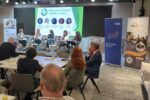

Jamie Broadley, Serco’s Group Head of Health & Wellbeing (far left), is taking to the MAD World Leaders Summit stage for one of the most talked-about topics in the industry currently: what can employers do on the wellbeing front, when pay can’t stretch further?
If you haven’t already nabbed your ticket, then you can register and see the full agenda, including all the speaker biogs, for MAD World Leaders’ Summit here!
Jamie is well placed to talk about this topic, given his vast ranging experience from working in high performance sport to the NHS to the corporate sector.
We talked to him to find out more ahead of his session…..
You have a background in performance sport as well as the NHS. To what extent are the skills you’ve learnt in these three different environments transferable?
I’ve been very lucky in my career where I’ve stumbled from one role to the next and each has given me valuable lessons which have enabled me to grow further in the next role.
The world of sport taught me personal resilience in spades which is very valuable in the often choppy waters of Workplace Wellbeing! It also gave me first hand experience of applying academic theory into the messy world of reality, to enable performance and longevity in what is often a fast moving and imperfect working context.
My time in the NHS built on this and gave me a deep appreciation for the everyday heroism of frontline service delivery and how this pulls and pushes against someone’s sense of wellbeing, getting them through the toughest experiences imaginable, yet often at personal cost.
It taught me how to find interventions in a world of no budget and no resource. It taught me how to navigate a hugely complex organisational system and how to develop the relationship skills to build trust with a truly diverse set of stakeholders.
And all of that has rolled me forward into my current role at Serco where the sheer scale and diversity of service delivery across 70,000 global colleagues sees me drawing on those experiences daily.
What are the biggest differences between working in Wellbeing in the NHS vs working in corporate vs working in sport?
I left the NHS towards the back end of Covid, so my recollections are very much rooted in the intensity of that experience, of which there are many far more eloquent accounts available than mine…
When I started in the NHS 5 years prior I was able to bring far more of a performance focus, borrowing from those sporting experiences. Towards the latter stages the focus was far more on surviving rather than thriving, trying to keep colleagues going through all the challenges that period brought. I’d hope that trend has reversed in recent years.
Whilst my role at Serco is in the corporate world we are still delivering frontline services, so many of the challenges are very familiar.
The biggest difference is in public perception and the impact that can have for our colleagues. In the NHS you had the generally positive public perception that went with it. At a government outsourcer that isn’t the case and with the current media environment that is tough. Our people do amazing work every day, keeping our communities safer, streets cleaner and services accessible, yet without that sense of societal recognition for their efforts.
There’s a lot of debate currently about the ‘best’ background for a career in this sector and also the role of qualifications. From your multiple experiences, plus your Master’s – do you think any experiences are particularly valuable in setting up for success in a Wellbeing Lead role?
This is a big question and it’s easy to see why it’s heavily debated. Wellbeing roles are in high demand yet are often scarce, with usually only a handful in any organisation, which leads to lots of questions about the best experiences to get to give an advantage when finding a route in.
For me, the most important thing is a blend between a variety of experiences, which allows a balanced perspective and approach to the role. In these roles you have to be a generalist, you have to work at all levels from board to ward, you need to have flexibility and you need to understand and build relationships across every aspect of a business.
I therefore am rarely very prescriptive about any particular background or experience, it’s more about exposure to different opportunities that’ll develop the personal skills to succeed. If you can find ways to help you communicate well, be likeable and build relationships, experience both practical service delivery and higher level strategy, understand the academic theory but translate it into realistic applications and develop plenty of personal resilience then you’ll be in a great spot to succeed in a role.
Your session at MAD World focuses on ‘Equity, Resilience and Financial Wellbeing: What Employers Can Do When Pay Can’t Stretch Further’. Can you give us a teaser into what you might talk about without giving too much away?
The topic of financial wellbeing is still, sadly, a key one when looking at wellbeing challenges organisations are facing up to. My perspective on this comes from my NHS background, where we had a real focus on public health and some of those socioeconomic drivers for wellbeing, and in my current role at Serco where we are large employer of frontline roles which have a broad variety of wellbeing challenges.
Across those we’ve explored lots of different interventions and solutions and I’m looking forward to sharing what we’ve found to work, what hasn’t and learning from the room on their experiences too.
What is the biggest thing you feel optimistic about, and pessimistic about, in the world of Workplace Wellbeing currently?
I can answer this with the same topic; psychological health and safety. It’s something we’ve really focused on at Serco, particularly with our work on ISO 45003, and we’re seeing the benefits. It’s encouraging to see others paying an interest, legislation starting to spread out of Australia and more providers making noise in the space.
This all gives me reason to feel optimistic that we backed the right horse with our focus on it and that others are coming along too, which will hopefully advance the thinking and give me challenge to help us improve our approaches.
However I am starting to check my watch a little and think that this focus has been around for a couple of years now and we haven’t yet seen the big strides we perhaps initially hoped. I’m hoping that this is because organisations and governments are doing the work and fully engaging with it and not that attention is starting to turn to the next shiny exciting thing.
What are you most looking forward to about the MAD World Summit on 9th October?
Us Heads of Wellbeing are often flying solo in our own organisations so I always welcome the opportunity to step outside the bubble and connect with peers, hear what they’re up to and put the world to rights! I also value these events for giving me a nudge to challenge existing thinking, consider other approaches and generally freshen up my mindset.
What would you say to persuade people to get out of their comfy PJs in front of Zoom and make the effort to go to meet fellow professionals face to face?
Given that I am usually the one sneaking off onto an earlier train to get back to the green and peace of the Peak District I am being highly hypocritical here, so let’s just say that if I’ve made the effort then it really must be worth it and you’ve got no excuse!
To hear Jamie and other high profile speakers in the Health and Workplace Wellbeing world talk, register for MAD World Leaders’ Summit on 9th October in London here
You might also like: