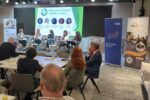

Google’s Global Occupational Health Leader Charlie Newton Chaired a panel on ‘unpacking psychosocial risk: what’s driving it – and how employers must adapt’ at recent event.
And who better to do this than someone who has not only lectured in Public Health and run her own Occupational Health company, but also knows what its like to be in the trenches, doing the job, at big corporations like Google and GE?
We caught up with her ahead to find out more…..
What led you into Workplace Wellbeing?
From the moment I began working in healthcare, I saw firsthand how health underpins every aspect of life – our thinking, our choices, our relationships, and ultimately our capacity to thrive.
Working across trauma, critical care, oncology and emergency departments gave me deep insight into how quickly illness can derail a person’s trajectory. Yet, I also observed a recurring pattern: we spend most of our effort treating disease rather than preventing it. That realisation ignited my passion for health‑promotion and disease‑prevention, especially at a scale where we can intervene before problems become entrenched.
Why Occupational Health?
You have the reach, the potential to impact many lives, whilst directly supporting business sustainability. I value the systems thinking, and ability to make change by designing programmes that improve employee health, while delivering measurable business value
Your panel session focused on ‘unpacking psychosocial risk’. Can you give us a taste of what you covered?
Pyschosocial risk, stress, burnout and mental health are often used interchangeably. We unpacked what we mean by psychosocial risk and how the context of the working environment shapes the psychosocial risk landscape and the actions that organisations need to consider.
You seem to have a wide remit. What is your biggest challenge and why?
OH professionals must evolve to tackle today’s health and business challenges. In the UK, traditional curricula focus on clinical skills but rarely cover the subtleties of workplace culture, organisational dynamics, or the strategic business acumen required for effective OH practice. Bridging that gap is essential for the profession to stay relevant and impactful.
How much extra complexity and difficulty do you think adding ‘global’ to a role brings?
Adding a global scope inevitably adds layers of complexity, yet it also magnifies the strategic impact of the role, as we design programmes that support the business at scale. At its heart, OH remains about identifying and managing health risks, but we must always remember that health is personal and local.
Is it a hard transition to take a programme up to global from regional?
Scaling a wellbeing programme from a regional rollout to a global one isn’t a leap into the unknown—it’s an evolution.
Globalisation, climate change and increased mobility mean many health challenges now cross borders, so the core concepts stay the same.
The real work is adapting those concepts to each market’s cultural norms, regulatory landscape and local health priorities. By building a flexible framework that accommodates regional nuances—whether that’s language, workplace customs or specific risk factors—we preserve the programme’s integrity, while ensuring it resonates everywhere.
You ran your own OH company at one point. What advice would you give to Health and Wellbeing Leads in companies buying services from providers?
Having been in both positions, I’ve learned that the biggest hurdle is the lack of a clear, strategic brief.
To become an intelligent customer, start by defining exactly what you need from the partnership. Three practical steps can help you do that:
- Move from “wellness” to risk‑management. Wellness and wellbeing are attractive buzzwords, but they don’t give you measurable targets
- Know your data. Before you engage a vendor
- Articulate your needs objectively. Translate the business impact of those risks into concrete outcomes
What is the biggest thing you feel optimistic about, and pessimistic about, in the world of Workplace Wellbeing currently?
I’m excited by how quickly apps and generative‑AI are making workplace health personal and widely accessible.
Their power, however, depends on educating clients to recognise their own needs—not just what we assume they need. Conversely, many firms still rely on a one‑size‑fits‑all, siloed model that separates physical, mental and social wellbeing, blurring the true risk picture and limiting the impact of any initiative.
You mention ‘design’ repeatedly on your LinkedIn profile…
I favour design-based thinking as it is a human‑centred approach to solving problems and creating innovative solutions.
It is usually an iterative process that emphasises empathy with the people you’re designing for, encouraging experimentation. Health is multi-dimensional and presents challenges which require a non-linear approach.
You might also like: