Karl Simons OBE, who received his OBE for services to mental health policy, is one of the leading voices in the Health, Safety and Wellbeing arena when it comes to the future of work. He believes we are at a pivotal moment in time regarding how the workplace will be shaped by AI:
“I firmly believe the ‘autonomous era’ that we are now in is – and will – continue to play a massive role over the years to come in how it impacts the safety, health and wellbeing of individuals. How they are supported will be very different because we will be able to surface information quicker to managers. We’ll be able to support individuals better.”
The industry must get AI-literate
He adds that anyone who has a remit which touches on employee safety, health and wellbeing, needs to make sure they inform themselves about this revolution.
“My advice, especially to anyone in Occupational Safety and Health (OSH), is to educate yourself and your business on what steps you should take. Speed of change is happening so quickly and you need to make sure you’re at the table, which you won’t be unless you have a good understanding of technology, data and AI. We have a big part to play in terms of how we affect culture within organisations.”
This is also a key message given by Chief People Officer Helen Matthews in our latest MAD Leaders Podcast on AI at work, for more see here
Occupational Safety and Health, he says, has evolved through three eras:
- compliance-based safety (1930s–1980s)
- behavioural based safety (1990s–2010s)
- and the current “autonomous” safety era (2020 – present)
The autonomous era, takes us into a fundamentally different safety landscape, using data to predict and prevent harm, shifting from lagging human insight to predictive digital-led insight.
AI is now able to take the vast amounts of information generated in the workplace to predict outcomes, and then inform humans about these predictions so adaptations can be made before harm happens.
These changes, says Simons, have led to a shift in how safety is understood and managed; they mean that employers can now allow employees to stay safe by anticipating risk in real time.
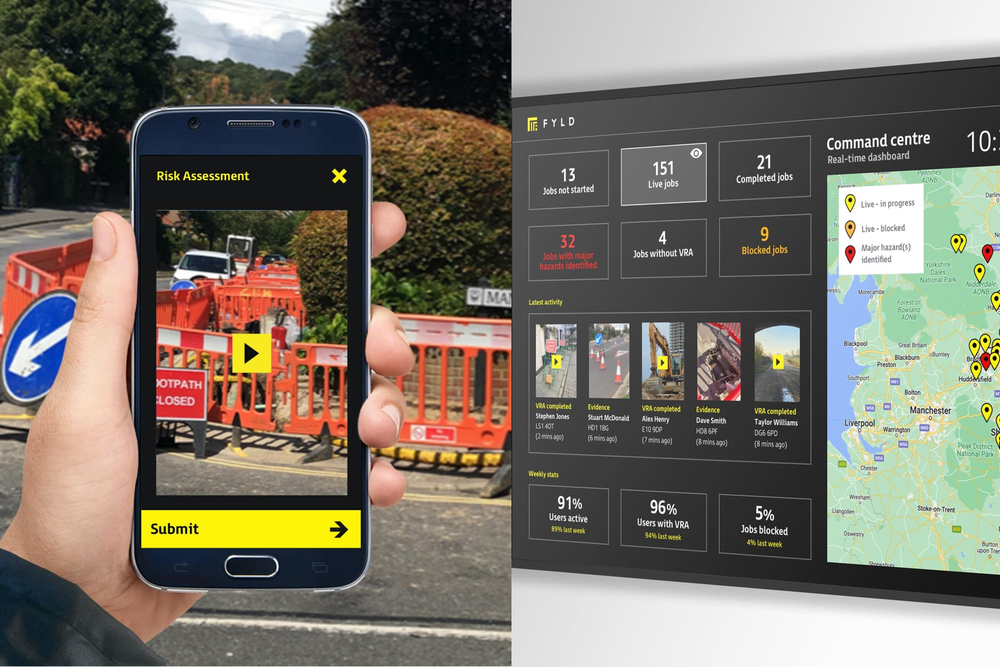
To put what this all means into context, we spoke to one of Simons’ clients using his AI technology, FYLD, which he co-founded, to explain the impact this is having on the employer, and where it could go in the (near) future.
AI in action case study: Southern Water
In 2023, Southern Water wanted to improve its risk assessment process.
“This used to consist of someone completing a bit of paperwork and this could lead to complacency, or people viewing it like a tickbox exercise and not truly seeing the potential of the hazards in front of them,” says Ricky O’Sullivan, Interim Director of Health, Safety, Security and Wellbeing at Southern Water.
The utilities employer then partnered with FYLD because it wanted to push the boundaries of what was possible and, as O’Sullivan says, “challenge ourselves and use innovation to solve a problem”.
From paper to digital
This meant moving from a paper-based system to a digitised, AI-powered one. Now, individuals can do a dynamic risk assessment on site at the point of work by talking into their mobile phone and describing the surroundings and what is happening. They could, for example, describe the noise, height and other hazards in their location.
One of the challenges is that talking to a phone, especially when you’re on your own, has been uncomfortable for some employees, especially those that aren’t digitally native. This has been overcome by face to face learning sessions to show the benefits of the technology.
After hearing the details, the tool then comes back instantly with control measures that need to be put in place to prevent harm. AI is also able to tap into other factors that the individual may not have thought about, or know about, like the fact the weather is about to change, or that a nearby school is about to let their pupils out at the end of the day.
Spotting trends and patterns
As well as supporting the employee better in the moment, this technology means O’Sullivan and his colleagues are able to harvest data from these interactions and start spotting patterns and trends.
“We can analyse common hazards and do some clever things off the back of this in a proactive way. Rather than, traditionally, you’d wait for an incident to occur and that’s how you’d learn, which is obviously tragic as someone’s been hurt,” he says. “Now we can put proactive interventions in place before the harm occurs.”
Thousands of people have been trained and the employer is now focusing on training-up contractors too. Since 2023 the employer’s lost injury frequency rate and harm rates have more than halved. It’s impossible to attribute this all to FYLD because the company has been going through a transformation strategy with many elements introduced, but O’Sullivan believes it’s been a “huge” part.
Much more potential to come with AI
O’Sullivan says the employer is just at the start of its AI transformation, in the “embedment phase” but he can see great potential with how this technology could be used more widely to address employee health and wellbeing issues.
“The possibilities are endless,” he says, especially when the tool is able to integrate physical environment data with specific health and wellbeing data about an individual.
“We are just scratching the surface on AI. Wouldn’t it be great if it could look at a combination of risk factors like the weather, where you are, what mood you’re in, how tired you are based on your workload and what hazards are in front of you, so we can see problems in a proactive way before an incident happens?”
The game changer…
This level of data integration is already possible, says Simons. The real game changer, he argues, will come when AI’s data capabilities are applied to human interactions in the workplace, with direct consequences for organisational culture.
“Culture is internal. You can’t see it, but you can feel it,” he explains. “Behaviour, on the other hand, is external. You can see it, you can act on it and it shapes culture.”
He offers the example of a manager frustrated that an employee has failed to meet their weekly targets. “Just as technology can identify unsafe acts or conditions in the physical world in real time, it can also detect behavioural deviations that explain why deadlines or outcomes are missed and surface those insights to a manager instantly. It can combine data about the individual and their behaviour with data about the environment they’re operating in, in a highly intelligent way.”
The future?
Simons paints a picture of a future where AI agents are constantly running checks across a workforce, based on its super-human report-reading skills, to pick up invisible, underlying data that affects human behaviour and performance. Then feeds this to managers.
“The AI system will prompt the right questions and deliver action-focused nudges before a human even realises what needs to be asked,” he says. “This is about using predictive analytics to prevent risk in ways we’ve never seen or imagined before.”
You might also like: