
Workplace wellbeing has grown incredibly quickly over the last decade as organisations increasingly recognise the links between work, mental health, organisational performance and workforce sustainability. With this growing recognition, we’ve seen more and more organisations appoint formal, wellbeing specific roles than ever before. But the growth of workplace wellbeing and the wellbeing profession has happened without a shared understanding of what good practice actually looks like and what effective wellbeing practice actually involves.
Why do we need to define the role of wellbeing professionals?
The absence of a shared foundational professional framework to clarify expectations of wellbeing roles, recognise the diversity of professional backgrounds, and support clearer pathways into and through wellbeing practice has consequences. In focus groups run by Affinity Health at Work, many practitioners said that whilst they feel passionate about the work, they are unsure about what “good practice” really looks like or how to build credibility and influence within their organisations.
Employers experience similar challenges. They want to invest in wellbeing but often struggle to recruit the right capability, govern wellbeing activity effectively, or move beyond reactive initiatives.
One of the things we heard repeatedly is that wellbeing professionals often feel they have to justify the existence of their role because people assume wellbeing is something anyone can do, it is not currently seen as a credible profession. However, one of the key messages from the research is that effective wellbeing practice requires real expertise.
This framework was designed to address the gap created by the lack of shared understanding by providing the first evidence-based, multidisciplinary framework that defines what competent wellbeing practice looks like – across various professional backgrounds and levels of seniority.
What the development of the framework involved
The need for clarity wasn’t just something we heard from practitioners — it was strongly felt by our Research Consortium (https://www.affinityhealthatwork.com/research-consortium), a network of employers, policymakers and experts committed to strengthening the evidence base, and sharing knowledge and best practice for work, health and wellbeing. Each year, Consortium members vote on the research agenda, choosing the issues most relevant to their work. In 2025, they selected the development of a wellbeing professional framework as their top priority.
Working with our multidisciplinary Steering Group and in collaboration with institutions including IOSH, SOM and the CIPD, we undertook a rigorous seven-stage -research process. This included evidence reviews and input from hundreds of wellbeing practitioners, employers, academics and professional bodies across HR, Occupational Health, Health and Safety and occupational psychology. Full details of the research process to develop the framework can be found in our free short research report, due to launch on our website on the 18th March.
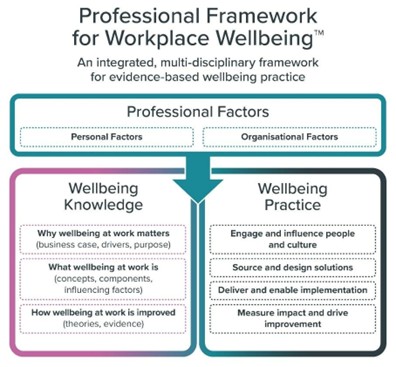
The Professional Framework for Workplace Wellbeing
The framework defines the 45 areas of knowledge, skills and professional factors needed for effective wellbeing practice, defining what competent wellbeing practice looks like across different professional backgrounds and levels of seniority.
How the framework will impact Workplace Wellbeing
For practitioners, the framework provides clarity on the knowledge, skills and capabilities that underpin effective practice. It helps practitioners understand what “good” looks like, build their confidence, strengthens professional identity and helps plan their development and progression.
For organisations, the framework offers something that has often been missing — a credible benchmark. Employers can use it to design roles, recruit the right expertise, build capability within teams and strengthen governance around wellbeing.
But perhaps the most important shift is how the framework reframes wellbeing practice as a strategic organisational capability grounded in prevention, psychosocial risk management, behaviour change, evidence and evaluation — not just a collection of initiatives or awareness activities. This shift has the potential to transform and strengthen the impact of wellbeing across organisations, a prospect we are very excited by.
What does this mean for wellbeing at work?
Ultimately, our hope is that this framework helps wellbeing move from something people and organisations do to something they are genuinely capable of delivering well — because the right skills, knowledge and professional standards are in place.
At Affinity, our mission is to improve the working lives of all. By equipping wellbeing professionals with the clarity and confidence they need, we believe this framework can play a meaningful role in achieving that which is why we are so excited to share this work.
Using the framework
The framework will officially launch on the 18th of March through a launch webinar and report. Most importantly, it will be freely available for organisations and practitioners to access.
To sign up to attend the launch webinar, please register via this link.
To help professionals apply the framework to their practice, Affinity have developed a self-assessment profiling tool, also due to launch on the 18th March. This tool will allow wellbeing practitioners to map their current knowledge and practice against the framework and identify where they feel confident and where they may want to develop further.
We are also working closely with professional bodies such as the Society of Occupational Medicine and IOSH as well as wellbeing qualification providers to explore how the framework can support professional standards and the development of specific training pathways.
Building on this work, Affinity Health at Work is developing a suite of training and development opportunities including training modules, interactive workshops and thought leadership groups aligned to the framework. These are designed to help practitioners build specific knowledge and capabilities at different stages of their career – accessing development at the point of need and helping wellbeing professionals achieve real impact in their work. These are due to launch later in Summer 2026.
About the author:

Sophie Walker is a Consultant at Affinity Health at Work, a multi-award-winning consultancy and research organisation, specialising in evidence-based wellbeing at work. Founded in 2006, Affinity’s mission is to improve the working lives of all. With a passion for using evidence-based approaches to identify and address workplace challenges and to support people and organisations to thrive together, Sophie works across various projects in the field of workplace health and wellbeing as well as psychosocial studies. After completing a BSc in Psychology and an MSc in Occupational Psychology, Sophie is excited to commence her Professional Doctorate in Occupational Psychology at Birkbeck, University of London in 2026.
You might also like: