
New research from Investors in People suggests many organisations may be overestimating levels of trust, with employees often staying silent, keeping evidence trails and trying to solve problems before speaking up.
Trust is often described as the foundation of a healthy workplace. It’s central to employee engagement, effective leadership and high-performing teams, and most organisations would say it’s something they actively encourage.
But new research from Investors in People suggests there may be a gap between how trust is perceived by organisations and how it’s experienced by employees.
The study, carried out by Censuswide among more than 1,000 employees and 500 HR leaders, found that while trust is widely valued, many employees still behave in ways that suggest they don’t always feel comfortable speaking up.
Behaviour tells a different story
Almost all employees (93%) said trust is important at work, while every HR leader surveyed agreed. More than eight in ten HR leaders also said employees are trusted to use their judgement.
Yet the day-to-day behaviours reported by employees paint a more complicated picture.
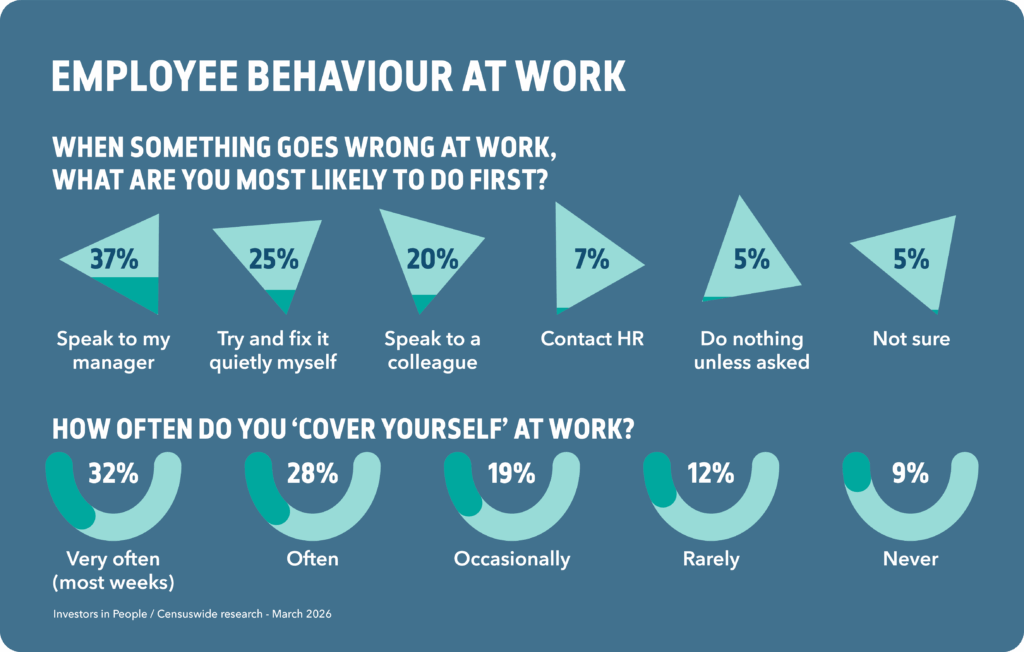
Around six in ten employees (61%) said they regularly “cover themselves” at work by keeping emails, screenshots or other records. Nearly two-thirds (65%) admitted they had avoided raising or speaking openly about something during the previous six months.
According to Eddie Salmon, Chief Operating Officer at Investors in People, organisations should pay close attention to these behaviours rather than relying solely on survey responses.
“Trust is not what people say in a survey or what appears in a values statement. It is what people feel safe enough to do.”
Silence can be costly
One of the biggest gaps identified by the research is how HR leaders and employees view speaking up when problems arise.
Almost half (49%) of HR leaders believe employees raise issues early when something goes wrong. However, one in four employees said they would first try to fix a mistake quietly before telling anyone.
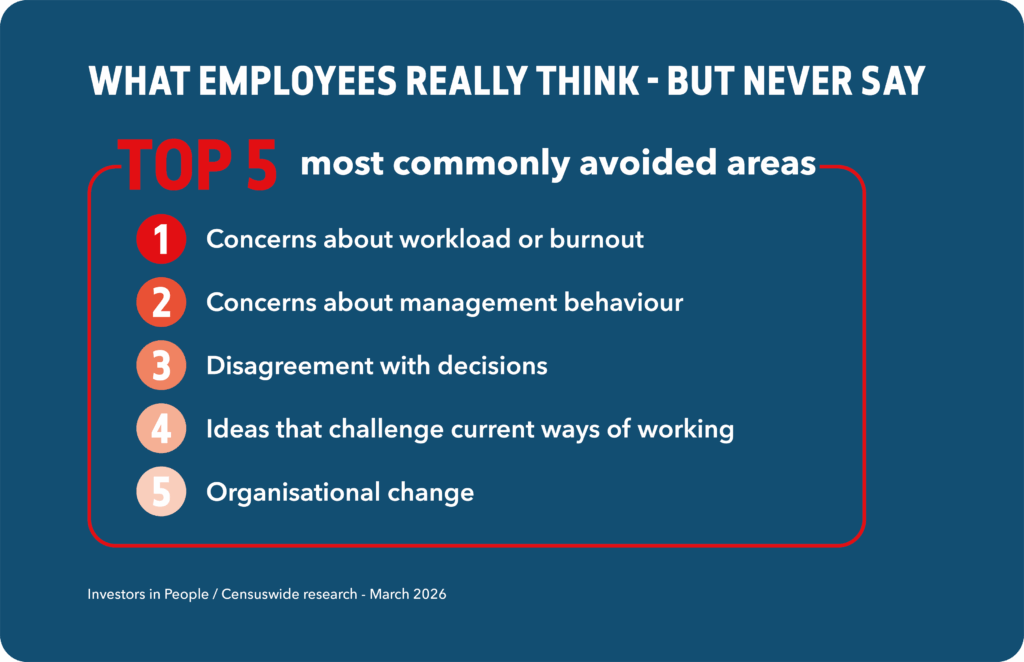
Employees were also most likely to avoid speaking up about workload and burnout, manager behaviour, disagreements with decisions, organisational change and ideas that challenge existing ways of working.
While these conversations may be uncomfortable, delaying them can allow issues to grow before organisations become aware of them.
As Salmon notes, silence should not automatically be interpreted as a sign that everything is working well.
“If people do not trust that speaking up will lead to meaningful action, the organisation loses the chance to fix root causes.”
Low trust changes how people work
The research also explored how employees behave when trust in leadership or the wider organisation is low.
Rather than feeling motivated to contribute more, employees were more likely to focus on protecting themselves, avoid taking risks, do only what was required or begin looking for another job.
HR leaders recognised these risks too. Nearly half (48%) identified reduced productivity as one of their biggest concerns when trust is low, while more than a third pointed to lower employee engagement.
These behaviours may not be immediately visible, but over time they can affect innovation, collaboration and organisational performance.
Managers play a critical role
The findings reinforce the influence managers have on employees’ experience of trust.
More than a third of employees said their manager would be the first person they’d speak to if something went wrong at work. At the same time, one in five said their level of trust in the organisation depended heavily on who their manager was.
HR leaders also highlighted poor leadership behaviour, inconsistent communication and varying manager capability as some of the biggest risks to trust within organisations.
The research suggests that even where organisational values are clear, employees’ day-to-day experience of trust often depends on the conversations they have with their immediate manager.
Trust is tested during change
Periods of organisational change appear to expose some of the biggest differences in perception.
More than half of HR leaders said decisions affecting employees were explained with clear reasoning and context, while only around a third of employees agreed. Similarly, HR leaders were considerably more likely than employees to believe staff were consulted before decisions were finalised.
These gaps highlight how communication during periods of uncertainty can have a significant impact on trust.
Employees may not always agree with organisational decisions, but understanding why those decisions have been made and feeling involved in the process can make a meaningful difference to how change is experienced.
Looking beyond trust surveys
The research concludes that organisations may benefit from looking beyond traditional engagement measures and paying closer attention to the behaviours that indicate whether employees genuinely feel safe to speak up.
That includes whether people admit mistakes early, raise concerns before problems escalate, challenge ideas constructively and feel confident asking for help.
Rather than relying solely on how employees rate trust in surveys, these everyday behaviours may provide a more accurate picture of workplace culture.
The full whitepaper, The Trust Paradox: Why Behaviour, Not Belief, Determines Trust, explores the findings in more detail.
The research was commissioned by Investors in People and conducted by Censuswide in February 2026 among more than 1,000 UK employees and 500 HR leaders.