
Increasingly, workplace wellbeing must be linked not just to employee health outcomes, but also to organisational performance. Without this connection, it is difficult to build a compelling business case, and wellbeing risks being seen as a “nice-to-have” rather than an essential part of long-term business strategy.
But how can this link be established? What do we even mean by “workplace wellbeing,” and which metrics can be reliably used to demonstrate its influence on both employee health and organisational success?
Why link wellbeing to performance?
As a wellbeing company that’s worked with thousands of organisations over the past 14 years, we understand the importance of this question. Leaders want clarity: if they invest in wellbeing, what is the return – for their people, and for the business?
The good news is that research is increasingly answering this. Jan-Emmanuel De Neve and his team at Oxford University, using Indeed’s vast dataset, have shown clear links between organisations that prioritise wellbeing and those that consistently perform at the top of stock exchanges. In other words, wellbeing isn’t just a moral or HR issue – it’s a financial and strategic one too.
Yet if you’re a business leader tasked with investment decisions, the practical question remains: what metrics should you focus on? In this article, we’ll cut through the complexity, share current best practice, and explain how we’ve worked with clients to build metrics into everyday wellbeing solutions that both prove impact and guide strategy.
1. A bird’s eye view: Different types of metrics
When it comes to measuring workplace wellbeing, there are many schools of thought, each with its own strengths and pitfalls. Broadly, metrics fall into three categories:
- Subjective measures: Asking employees directly how they feel – via surveys, pulse checks, or experience sampling. These capture evaluative wellbeing (job satisfaction), affective wellbeing (day-to-day emotions like happiness or stress), and eudaimonic wellbeing (a sense of meaning and purpose at work). They provide a direct line into the employee experience. The downside? Surveys are prone to bias and fatigue, and participation can dwindle if questions are too frequent, long, or if employees don’t see action in response to their input.
- Objective measures: Using HR and operational data such as sickness absence, turnover, retention, accident rates, or productivity. These are often business-critical and easier to link to financial outcomes. But here too, there are gaps. A 2024 GRiD survey found that while 82% of employers record sickness absence, only 69% track its impact, and many lack consistent systems across departments. Hybrid work has made absence data even harder to interpret. In other words: the numbers are only as reliable as the way they’re collected.
- Participation and engagement metrics: Looking at attendance at wellbeing events, uptake of resources, or activity within wellbeing champion networks. On their own, they don’t measure outcomes. But when integrated into a programme, they provide an important success metric, a stepping stone on the path to moving the needle on subjective and objective measures. In fact, these are some of the most practical and accessible insights we can provide as a wellbeing company, helping clients to demonstrate traction and engagement in a way that supports their wider measurement efforts.
Where do you begin, then, given there are so many options? The challenge is to avoid measuring everything – or the wrong things – and instead home in on what really matters.
2. Homing in on what really matters: Clearer definitions
This is where the work of De Neve and colleagues is particularly helpful. They argue that workplace wellbeing should be defined through three clear dimensions:
- Evaluative wellbeing – “How satisfied are you with your job overall?”
- Affective wellbeing – “How happy or stressed did you feel at work this week?”
- Eudaimonic wellbeing – “How purposeful and meaningful do you find your work?”
These questions are simple, accessible, and directly aligned with decades of wellbeing science. They provide a clear outcome framework that avoids confusing drivers (like pay, flexibility, or relationships) with the wellbeing outcomes themselves.
For organisations, this is powerful. It means you can measure wellbeing directly, while also analysing the drivers behind it to inform interventions. For example, one company may find that while job satisfaction remains steady, stress scores are spiking – prompting a review of workloads or team structures. Another may identify strong happiness scores but low purpose, suggesting the need for clearer links between individual roles and organisational mission.
And because the questions are light-touch, they can be asked regularly – helping leaders keep a real-time pulse on employee wellbeing rather than relying on an annual snapshot.
3. In practice: Start by measuring what you can
Theory is important – but you have to start somewhere. This is where, as a wellbeing company, a central part of our role is to build measurement into the solutions we deliver, so our clients can demonstrate effectiveness from day one. Here are some examples that show the different approaches we’ve taken, shaped by what our clients told us they needed to measure.
Engagement with wellbeing initiatives
Our Wellbeing Engagement Dashboard gives leaders instant access to participation and outcome data. They can track attendance, monitor engagement, and better align future initiatives with employee needs or business priorities.

Matt Wilson, UK Wellbeing Lead at Computacenter, explains:
“Instant access to our data gives me the opportunity to demonstrate the value of our activities to leadership. Seeing numbers track upwards helps us plan future sessions and make the best use of resources. Metrics transform wellbeing from being seen as a ‘soft’ area into a strategic driver of performance and culture.”

And as Lynzie Kane, Head of Workplace Wellbeing, Diversity & Inclusion at Churchill Services, put it:
“The dashboard is an essential resource in conversations with senior leaders. Whether I’m building a business case or showcasing impact, the Engagement Tracker helps me tell the story of our wellbeing work. It’s not just about the data – it’s about the story the data tells and how it connects to our people.”
Activity of the wellbeing team and peer networks
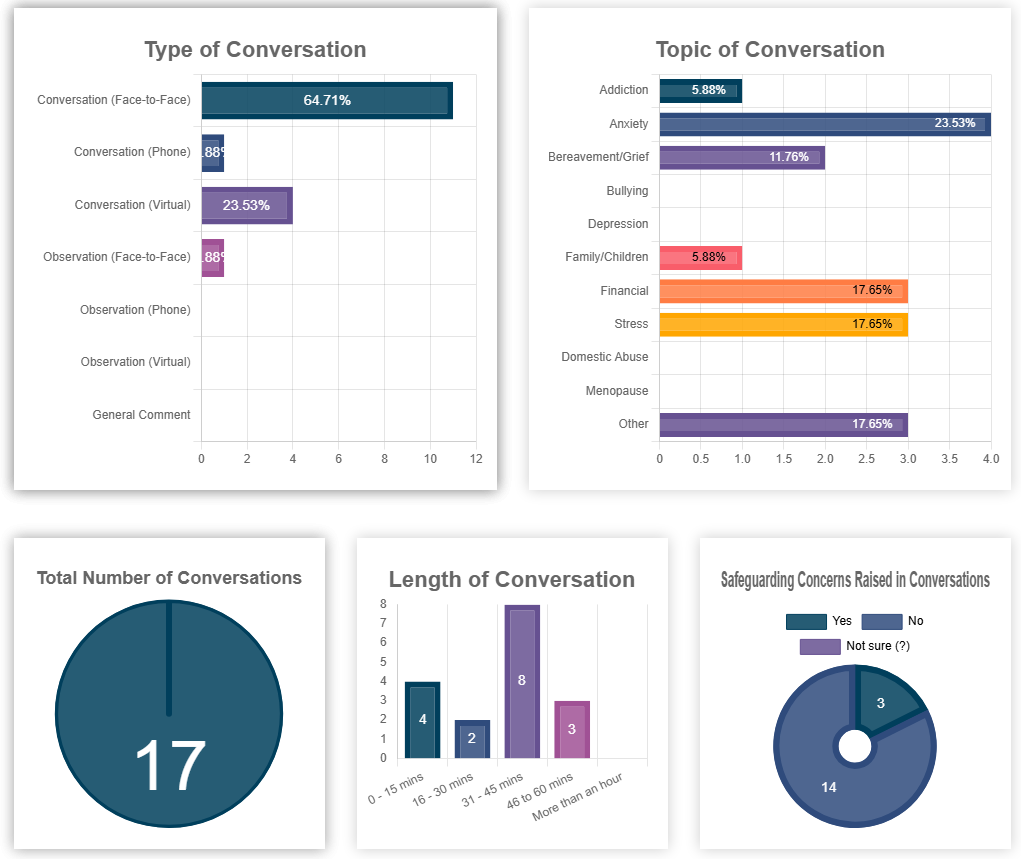
Our Wellbeing Insiders Platform has an inbuilt tool for logging and tracking conversations and activities by the wellbeing team, champions and mental health first aiders. One-to-one conversations, sometimes of an extremely sensitive nature, are a crucial part of wellbeing work – but traditionally, insights from them went unrecorded, exposing employees, wellbeing teams and organisations to unnecessary risk.
Our Log Your Conversation tool changes this – capturing trends, safeguarding concerns, and emerging issues in real time.

Amanda Studholme, Health & Safety Manager at Futamura, shared:
“This tool acknowledges the emotional impact of difficult interactions and supports reflective practice. With more people using it, the company gets a better picture of where we are with health and wellbeing.”
Visibility of grassroots activity within wellbeing champion networks
Through gamification and our Wellbeing Insiders Insights, managers can see how wellbeing champions are engaging in self-development and proactive initiatives. This helps keep champion networks energised and allows leaders to make informed decisions about future wellbeing investment.
One of our clients told us:
“Seeing which champions were consistently active gave us a grassroots litmus test of engagement – we could offer peer support or recognition to those going the extra mile.”
Together, these tools reduce reliance on surveys, build richer pictures of wellbeing, and – crucially – help leaders act quickly on insights.
Conclusion: Clarity, flexibility, and action
There is thankfully increasing clarity on how workplace wellbeing should be defined and measured. De Neve’s framework provides a scientifically grounded starting point, while a range of objective, subjective, and engagement metrics can be layered on to build a more complete picture.
But each organisation is unique. A wellbeing strategy in a manufacturing business will look different from one in professional services. What matters most is that the metrics chosen provide actionable insights – guiding continuous improvement and helping organisations adapt to the ever-changing challenges of a VUCA world.
The bottom line? Workplace wellbeing is not just about looking after employees – it’s about building organisations that thrive. And when you measure it well, you can prove it.
About the author:

After a 15-year corporate career, Angela Steel retrained in nutrition in 2009 and gained an MSc in Organisational Psychology at Birkbeck in 2023. She founded SuperWellness in 2011 and is a strong advocate for the role of business as a force for positive change, with a firm belief that wellbeing is central to this mission. SuperWellness runs regular free events on a range of topics aimed at business leaders and wellbeing teams.
References:
Bloom, N., Liang, J., Roberts, J., & Ying, Z. J. (2015). Does working from home work? Evidence from a Chinese experiment. Quarterly Journal of Economics, 130(1), 165–218. https://doi.org/10.1093/qje/qju032
Chartered Institute of Personnel and Development. (2023). Health and wellbeing at work survey report 2023. https://www.cipd.org/uk/knowledge/reports/health-wellbeing-work
De Neve, J.-E., & Ward, G. (2023). Why workplace wellbeing matters: The science behind employee happiness and organisational performance. Cambridge University Press.
Deloitte. (2020). Mental health and employers: Refreshing the case for investment. Deloitte LLP. https://www2.deloitte.com/uk/en/pages/consulting/articles/mental-health-and-employers-refreshing-the-case-for-investment.html
Group Risk Development. (2024, October 22). A third of employers still do not record the impact of sickness absence. https://grouprisk.org.uk/2024/10/22/grid-research-a-third-of-employers-still-do-not-record-the-impact-of-sickness-absence/
Harter, J. K., Schmidt, F. L., & Hayes, T. L. (2002). Business-unit-level relationship between employee satisfaction, employee engagement, and business outcomes: A meta-analysis. Journal of Applied Psychology, 87(2), 268–279. https://doi.org/10.1037/0021-9010.87.2.268
Krekel, C., Ward, G., & De Neve, J.-E. (2019). Employee wellbeing, productivity, and firm performance (CEP Discussion Paper No. 1605). Centre for Economic Performance, London School of Economics. https://cep.lse.ac.uk/pubs/download/dp1605.pdf
McKinsey & Company. (2022, July). Survey fatigue? Blame the leader, not the question. The Organization Blog. https://www.mckinsey.com/capabilities/people-and-organizational-performance/our-insights/the-organization-blog/survey-fatigue-blame-the-leader-not-the-question
Oswald, A. J., Proto, E., & Sgroi, D. (2015). Happiness and productivity. Journal of Labor Economics, 33(4), 789–822. https://doi.org/10.1086/681096
PricewaterhouseCoopers. (2021). Putting purpose to work: A study of purpose in the workplace. PwC. https://www.pwc.com/purpose-study
Qlearsite. (2024). Sickness absence management: What you need to know. https://www.qlearsite.com/blog/sickness-absence-management
UK Health and Safety Executive. (2022). Management standards for work-related stress and the HSE stress indicator tool. HSE. https://www.hse.gov.uk/stress/standards
UK Office for National Statistics. (2011). Measuring what matters: National statistician’s reflections on the national debate on measuring national wellbeing. ONS. https://www.ons.gov.uk/peoplepopulationandcommunity/wellbeing/articles/measuringwhatmatters/2011-07-25
You might also like: