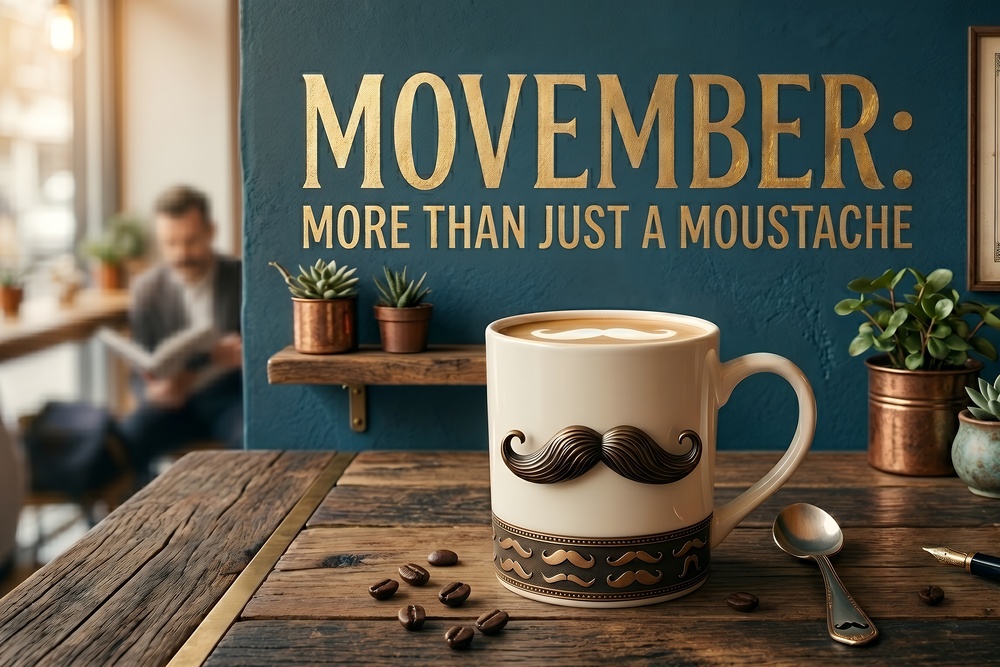
Movember can be a useful catalyst for men’s health at work – but the biggest opportunity is to use November to start conversations and make practical changes that last all year.
Every November, Movember puts men’s health firmly on the agenda, with its work focused on three major areas: mental health and suicide prevention, prostate cancer and testicular cancer.
For employers, that makes it a valuable opportunity to engage men who may not routinely seek out workplace health and wellbeing support.
But there is a danger that men’s health becomes another awareness campaign: grow a moustache, share some statistics, raise some money – and move on.
The more useful question for employers is: what can we do differently because of Movember?
Here are seven practical places to start.
1. Ask men what they actually need
Don’t assume that the same wellbeing offer works equally well for everyone.
Use Movember as a reason to listen. Ask male employees what gets in the way of looking after their health, what support they would use and what would make it easier to seek help.
Consider different groups too. The needs of a young man starting his career may be very different from those of an older employee managing caring responsibilities, menopause at home or a long-term health condition.
Employee listening can turn a campaign into useful intelligence for your wider health and wellbeing strategy.
2. Make conversations easier – not compulsory
Mental health and suicide prevention are central to Movember’s work, which includes encouraging stronger social connections and giving people practical tools to start conversations when someone may be struggling.
Employers can take the same approach.
Give managers simple guidance on how to check in with colleagues, recognise changes in behaviour and signpost appropriate support. Create opportunities for informal conversations rather than relying entirely on formal wellbeing interventions.
And don’t make disclosure the price of receiving support. People should be able to access help without having to explain everything that is going on.
3. Put physical health on the agenda
Movember isn’t just about mental health.
Prostate cancer is the most commonly diagnosed cancer in men in the UK, while testicular cancer is the most common cancer among young men globally.
Employers don’t need to become healthcare providers, but they can make relevant information easier to access and encourage employees to seek appropriate medical advice.
That could include signposting reliable information, promoting existing health-check or occupational-health provision, and making sure employees understand how to access their GP or other healthcare services.
4. Look at the barriers created by work itself
This is where men’s health moves beyond an awareness campaign.
Ask whether workload, working hours, travel, shift patterns, workplace culture or lack of flexibility are making it harder for men to look after themselves.
Are men taking breaks? Are they working excessive hours? Do they feel able to attend medical appointments? Are managers rewarding constant availability?
A wellbeing programme cannot compensate indefinitely for a working environment that makes healthy behaviour difficult.
5. Make support accessible to the men you find hardest to reach
Some men may be less likely to engage with traditional workplace wellbeing communications.
Think about where and how you reach them.
For frontline, shift or mobile workers, that might mean face-to-face conversations, team briefings, physical materials or support embedded into existing processes rather than another email from HR.
Movember itself emphasises meeting men where they are and recognising that there is no one-size-fits-all approach.
The same principle applies at work.
6. Don’t make men’s health a men’s responsibility alone
The strongest workplace approach shouldn’t isolate men’s health from the wider health and wellbeing strategy.
Consider how men’s health connects with financial wellbeing, family and caring responsibilities, physical activity, mental health, inclusion, occupational health and healthy work design.
And think about allies. Women, managers, senior leaders and colleagues all have a role in creating a culture where men can talk about health and ask for help without stigma.
7. Use November to find out what happens next
Perhaps the most important step is to decide before Movember starts what you want to learn from it.
Instead of measuring only moustaches grown, money raised or people attending an awareness session, consider measuring engagement with support, employee feedback, conversations with managers, referrals or signposting and the issues employees say they need help with.
Then use those insights to inform your health and wellbeing strategy for the year ahead.
Movember should be the starting point, not the strategy
There is nothing wrong with having some fun with Movember. Campaigns can create visibility, break down barriers and give people a reason to start conversations.
But the real opportunity comes when those conversations lead somewhere.
Better access to support. More confident managers. Healthier working practices. Earlier action. And a culture in which men feel able to look after their health before they reach crisis point.
Movember gives employers a moment to put men’s health in the spotlight. The challenge is to make sure it doesn’t disappear again when the moustaches do.
Express your interest in joining the Manbassador Everest Challenge for Men’s Health Month this November: https://activeteams.co.uk/manbassador
You might also like: