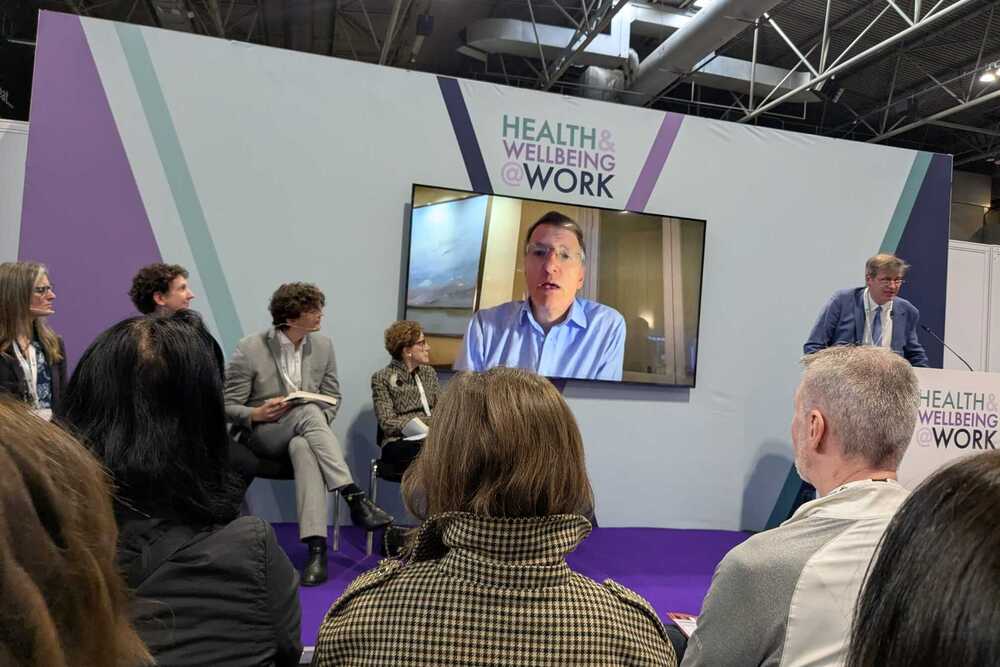
The Health and Wellbeing at Work event returned to the NEC Birmingham this March, bringing together employers, policymakers, clinicians and suppliers to tackle one of the most pressing challenges facing organisations today: how to keep people healthy, engaged and in work.
Now under the ownership of Mark Allen Group, the long-established event continues to be a “must attend” for professionals with responsibility for employee health and wellbeing.
Attending this year as a roving reporter for Make A Difference Media & Events, one thing was clear: the conversation is shifting rapidly – from why employee health and wellbeing matters to how to make it truly effective.
Here are my key takeaways from the day.
A system under pressure: the role of work in health
The event opened with a series of high-profile panel discussions exploring the intersection of work, health and policy. Experts including Dr Zofia Bajorek (IES), Dr Shriti Pattani (NHS England) and Professor Dame Carol Black tackled a fundamental question: “Is work still good for your health?”
The answer, as ever, is complex. While good work can support physical and mental wellbeing, poor work design can do the opposite. A recurring theme was that too many organisations are still focusing on changing the individual – rather than addressing the root causes within the workplace itself.
As Dame Carol Black highlighted, long-term systemic change remains difficult due to:
- Short political cycles
- Complex health and employment systems
- A lack of clarity among employers about their responsibilities
There is growing hope that the Keep Britain Working Review will act as a catalyst for meaningful collaboration between government, employers and healthcare providers.
From “Why” to “So What?”: a shift in the conversation
Beyond the formal sessions, informal conversations revealed a noticeable shift in mindset.
“We’ve got all the data and evidence – now we need to focus on the ‘so what’.”
Many attendees expressed a desire to move beyond awareness and business cases, towards practical action and measurable impact. There was also a call for greater boldness:
“If we’re going to move the dial, we can’t be afraid of being controversial.”
This reflects a growing frustration that, despite years of progress, some organisations are still not addressing the fundamental drivers of poor employee health and wellbeing.
Legal responsibilities still not understood
One surprising – and concerning – insight was that many organisations still lack awareness of their legal obligations.
Several attendees highlighted that, even in 2026, some employers do not fully understand the requirement to:
- Conduct organisational stress risk assessments annually
- Carry out individual assessments where needed
These are not optional extras – they are a critical part of managing psychosocial risks and supporting employees to stay in or return to work. As one participant noted, understanding the design, organisation and management of work is essential if organisations are serious about improving wellbeing outcomes.
Prevention over cure: a clear direction of travel
Across conversations with exhibitors, one theme came through strongly: prevention is now the priority. Organisations are increasingly looking to:
- Identify risks earlier
- Support employees before issues escalate
- Reduce reliance on reactive interventions
As one provider observed:
“There’s genuine interest in improving workplaces—not just responding when things go wrong.”
This shift aligns closely with national policy direction and the wider “healthy working lifecycle” approach.
Rethinking responsibility: employers, individuals and the State
Another emerging trend is the blurring of responsibilities between employers, the NHS and individuals.
Interest in health screening and proactive health management is rising – but questions remain:
- Who is responsible for prevention?
- Where does employer support begin and end?
- How should this align with public health systems?
There is a growing sense that responsibility is becoming shared and interconnected, particularly with the NHS increasingly expected to focus on supporting people to remain in or return to work.
Engagement challenges: less is more
A recurring challenge is overwhelm – both for employees and for those designing wellbeing strategies.
“We need to stop throwing resources at apps and benefits and focus on the actual need.”
Key insights included:
- Interventions must be realistic – what someone would be happy to access even on their worst day
- Small, incremental changes can drive meaningful impact
- Overloading employees with options can reduce engagement
This marks a shift away from “more is better” towards targeted, purposeful intervention design.
The critical role of line managers
One of the strongest and most consistent messages from exhibitors was the importance of line managers. Even the best-designed health and wellbeing programmes can fail if managers lack the skills and confidence to support their teams. Key focus areas include:
- Training managers to have compassionate conversations
- Supporting employees through serious health conditions
- Setting clear boundaries while maintaining empathy
As one expert noted:
“Compassion isn’t about being a pushover—it’s about consistency, boundaries and understanding.”
There is also growing interest in better leveraging wellbeing champions to support this effort.
Change, uncertainty and the need for better work design
In a world shaped by geopolitical uncertainty, economic pressure and constant organisational change, many employers are re-evaluating their approach. There is increasing recognition that:
- Change itself is a major driver of stress
- Wellbeing strategies must account for uncertainty
- Returning to the fundamentals of good work design is essential
However, this is easier said than done.
“We know what good work looks like – but implementing it is complex and takes time.”
There is also a growing challenge to the idea that wellbeing always means comfort. Some organisations are exploring how to balance support with stretch, recognising that growth and challenge can also contribute positively to wellbeing.
Spotlight on innovation: integrated workplace health solutions
The event also saw the launch of new solutions aimed at addressing long-standing challenges in workplace health. One notable development was the introduction of Spire Healthcare’s end-to-end workplace health model, bringing together prevention, advisory services and treatment into a single, integrated offering.
This approach reflects a broader industry shift away from fragmented services towards joined-up, lifecycle-based support.
With 2.8 million working-age adults in the UK currently inactive due to health issues – and sickness absence costing businesses thousands per employee each year – the need for earlier intervention and coordinated care has never been greater.
Data shared at the event reinforced this, showing that:
- Early access to treatment significantly improves outcomes
- Fast intervention can drive return-to-work rates of over 90%
A sector at a turning point
Perhaps the most striking takeaway from Health & Wellbeing at Work 2026 is that the sector is at a tipping point.
There is no shortage of data, solutions and awareness. But the challenge now is execution.
Organisations must move beyond: reactive programmes, over-reliance on individual behaviour change and fragmented approaches. Instead they need to focus on work design, manager capability, prevention, early intervention and system-level change.
The conversations at this year’s event were encouraging – but also challenging. There is a clear appetite for change, and a growing recognition that current approaches are not enough. The next phase for workplace health and wellbeing will require greater collaboration between employers, government and healthcare, more courageous conversations and a relentless focus on what actually works.
You might also like: