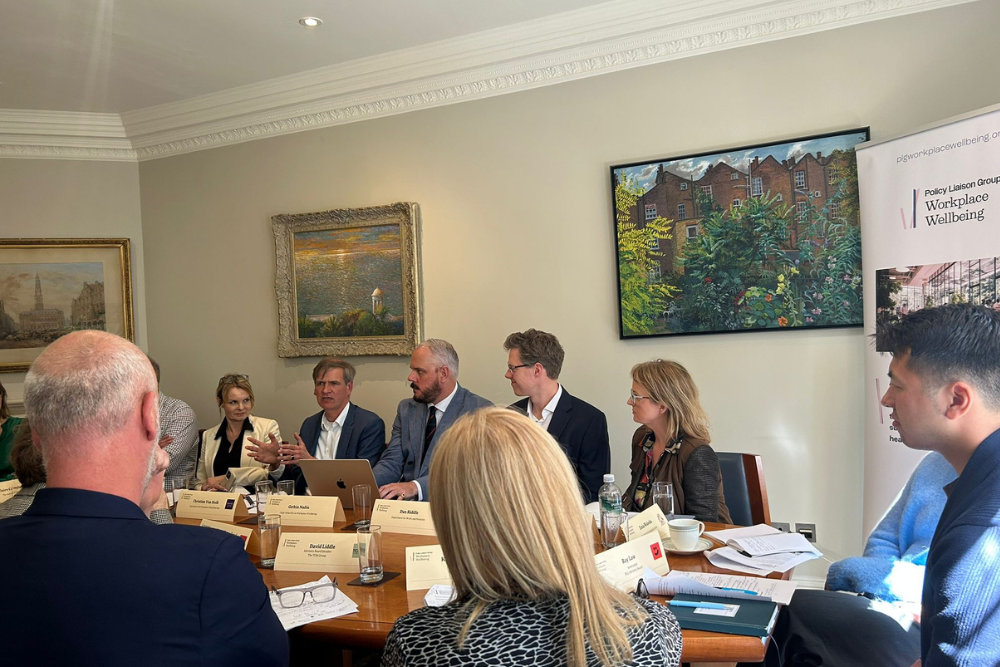
When Dame Carol Black gathered wellbeing leaders, economists and international experts in Westminster recently, one country kept resurfacing in the discussion: Denmark. Not because it spends dramatically more, but because it has built a system designed to intervene early, align incentives and keep people connected to work. The contrast with the UK was stark.
A system built on late intervention
The roundtable took place shortly after the King opened the new Parliament with a renewed focus on economic security. Yet the discussion suggested that the UK’s current approach to workforce health is still shaped by a reactive model that waits for people to fall out of work before meaningful support begins. With long term sickness rising and the NHS absorbing pressures it was never designed to carry, the consequences are becoming increasingly difficult to ignore.
Dame Carol Black set the tone early. “For too long, our system has intervened only after people have already fallen out of work,” she said. Support often begins only once someone has already left work, making recovery slower, more expensive and far less successful. Prevention, she argued, must become the organising principle rather than a hopeful aspiration.
Management capability has been eroded
Participants agreed that the UK’s systems are structurally misaligned. Managers are often expected to identify and respond to wellbeing issues, yet many lack the time, training or institutional backing to do so. Years of efficiency driven restructuring have hollowed out management capability. As a result, disengagement often begins long before sickness absence. Employees feel invisible, unheard or unsupported, and by the time problems surface formally, they are already entrenched.
This erosion of capability is becoming more significant as workplaces adopt AI and automation. While these technologies can improve efficiency, they risk intensifying pressure if productivity expectations rise without corresponding improvements in management support and workplace culture. Good work can be therapeutic, but only when organisations are safe, supportive and flexible enough to accommodate illness or disability.
What Denmark gets right
This is where the Denmark comparison becomes instructive. Danish employers, government bodies, welfare services and insurers work together to intervene early and keep people connected to work wherever possible. The Danish approach treats workforce wellbeing not as a separate social issue, but as part of long term economic strategy.
As Tobias Wermuth Simonsen explained, the aim is not simply compassion. “If you want to solve problems affecting young people, you have to involve them directly and build systems that are flexible enough to meet people where they are.” The model is designed to strengthen profit, employment and innovation at the same time.
The UK, by contrast, often treats wellbeing and productivity as competing priorities. Other countries have already shown that this trade off is unnecessary. The Danish model demonstrates that when incentives are aligned, wellbeing becomes a driver of economic performance rather than a cost to be managed.
Mental Health as the major outlier
Christian van Stolk highlighted another uncomfortable truth. Mental health is now the major outlier driving long term sickness and economic inactivity in the UK, particularly among younger people. Several comparable European countries have reversed these post pandemic trends. Britain has not.
“What worries me most is that mental health is now the major outlier driving long term sickness and economic inactivity,” he said. By the time support arrives, many people are already disconnected from work entirely, making a successful return far harder. Without earlier intervention and stronger coordination, participants warned, the UK will continue to fall behind its peers.
The missing role of insurers
The roundtable also explored the role insurers could play in a more preventative system. Income protection and salary protection models create incentives to support rehabilitation and early intervention. In many countries, insurers form part of the wider wellbeing ecosystem. In the UK, they remain relatively peripheral.
Participants argued that a more coordinated public private approach could help shift the system away from crisis response and towards prevention, easing pressure on both the NHS and welfare system over time.
A need for cross government coordination
Another recurring theme was the need for stronger cross government coordination. The Department for Work and Pensions cannot drive long term systems change alone. Participants stressed the importance of closer alignment with the Department of Health and Social Care, HM Treasury, employers and external stakeholders.
Without this, the UK risks continuing to rely on fragmented interventions that fail to address the underlying causes of inactivity and workforce disengagement.
Turning consensus into action
Gethin Nadin warned of another risk:
One of the biggest risks with reviews like this is that momentum fades. Governments change, priorities shift, and recommendations quietly disappear. The challenge now is turning broad agreement on the problem into coordinated action that keeps people healthier, more engaged, and connected to work for longer.
The King’s Speech referenced welfare reform, apprenticeships and measures to tackle youth unemployment, but offered limited detail. For participants at the roundtable, this reinforced the need for sustained focus. Britain’s wellbeing and workforce challenges will not be solved through isolated initiatives or short term reforms. They require a cultural shift that recognises wellbeing as a foundation of economic resilience rather than a competing priority.
A choice about the future
The question is no longer whether the UK can learn from countries like Denmark. It is whether the next phase of reform will recognise that wellbeing and economic resilience are inseparable. Countries that intervene early and align incentives are already seeing the benefits. The UK now faces a choice between continuing with a reactive model or building a system that keeps people healthier, connected to work and able to contribute for longer.
You might also like: