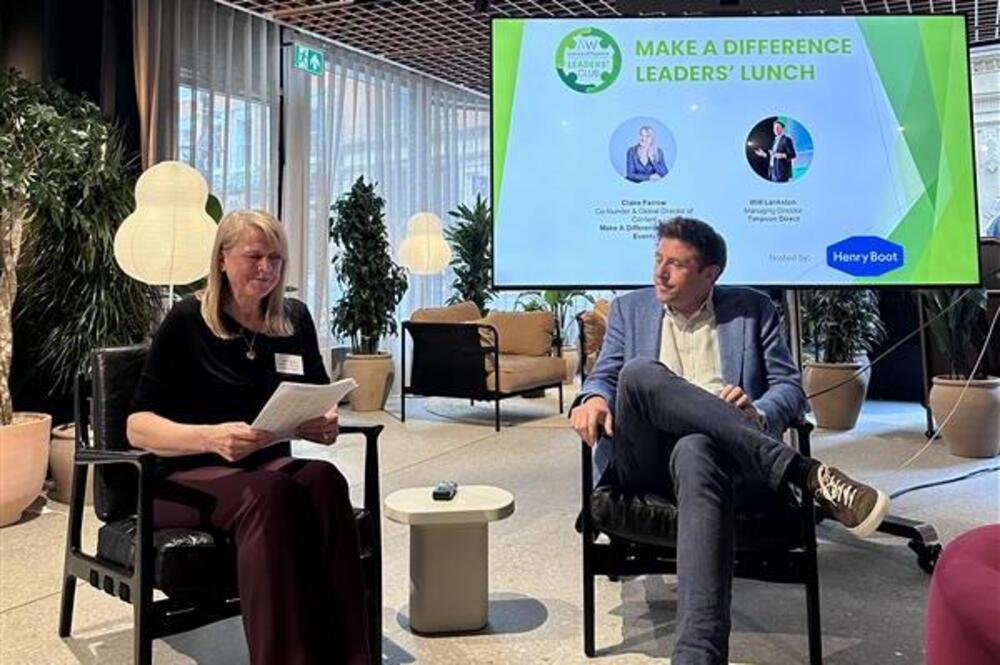
Leaders from the North of England gathered in Manchester for the latest Make a Difference Leaders’ Lunch to tackle a persistent challenge: how to keep workplace culture, employee health and wellbeing firmly on the Board agenda – especially in times of competing priorities.
Hosted by property development firm Henry Boot, the event brought together decision-makers from multinationals, public sector bodies and challenger brands. Guests also toured Virgin Media O2’s wellbeing-focused offices at Island – an environment designed to reinforce how physical space can support culture, health and performance.
At the heart of the session was a candid fireside chat with Will Lankston, Managing Director of Timpson Direct, followed by lively roundtable discussions. The result? A wealth of practical insight into embedding wellbeing into organisational DNA.
This article captures some of the key themes and ideas shared on the day. However, as with all Make a Difference Leaders’ Lunches, much of the real value lies in the depth of peer discussion and shared experience in the room. If you’d like to attend future events and you’re not yet a member of the Make a Difference Leaders’ Club, you can find out more and apply to join here.
If you treat people well… they’ll do a good job
Timpson Group is widely known for its people-first ethos. Their website clearly states: “Looking after colleagues is our number one priority”. But as Will Lankston made clear, this isn’t about altruism. It’s about business.
Rather than positioning colleague wellbeing as a standalone initiative, Timpson integrates it into every decision. Leaders sense-check actions by asking one simple question: what impact will this have on our colleagues? Everything that they do is designed to empower colleagues to feel and operate at their best
“We’re not there to tell people what to do – we’re there to remove barriers so they can do their job.”
This clarity is reinforced through its “upside down management” philosophy, where frontline employees are considered the most important people in the business – and leaders exist to support them.
Simple metrics, powerful impact
One of the standout lessons from Timpson’s approach is its simplicity. They even have a “Cut the Crap Committee”.
Instead of complex engagement surveys, the business focuses on two core measures:
- A weekly “How are you feeling?” score out of 10
- An annual “Happy Index” measuring how supported employees feel by their manager
These metrics are not just tracked – they drive accountability.
“Leaders can survive poor figures – but no one survives two poor happy indexes.”
This approach resonated strongly with attendees, many of whom noted that overly complex surveys often fail to generate honest or actionable insights.
Why leadership behaviour matters more than benefits
While Timpson offers an extensive range of benefits – from free holiday homes to counselling (including both in-person options and support through mental health app Heard). Lankston was clear that benefits alone are not the answer.
“Lots of organisations focus on benefits as something to sell to employees. For us, it’s about what will actually make the biggest impact.”
Roundtable discussions echoed this sentiment. Delegates agreed that:
- Wellbeing initiatives often fail when they are detached from leadership behaviour
- A “culture of care” must underpin any offering
- Employees value feeling heard, known and supported more than any perk
One attendee summarised it succinctly: “Wellbeing doesn’t come from a programme – it comes from the work itself and relationships with people.”
Breaking down silos: from ownership to integration
A major discussion point of the event was how to overcome organisational silos that prevent wellbeing from being embedded.
Having recognised that people and culture are fundamental to business success, Timpson’s joined-up approach stands out. Induction, learning and development, organisational design and management KPIs are all aligned with a wide range of health and wellbeing support and benefits – underpinned by a consistent understanding of their people, built through spending time with them and genuinely listening.
Timpson’s lean structure and shared purpose help avoid fragmentation. But for many organisations, this remains a challenge.
Key strategies discussed included:
- Shared accountability: Moving wellbeing beyond HR into leadership KPIs
- Integrated data: Combining metrics across functions to create a holistic view
- Cross-functional collaboration: Aligning HR, health & safety, and operations
Getting the Board’s attention: data, stories and regulation
One of the biggest barriers identified was simply being heard at Board level.
Delegates highlighted the tension between:
- Data-driven decision-making (favoured by Boards)
- Human experience and storytelling (essential for understanding impact)
The solution? Use both.
- Quantitative data to demonstrate ROI and risk
- Lived experience to build empathy and urgency
“If it’s a legal obligation, it has to be discussed – it can’t be pushed aside.”
Some organisations are also leveraging regulation and governance frameworks to ensure wellbeing remains on the agenda. For example:
- B Corp certification embedding social responsibility into governance
- Increasing enforcement by the Health and Safety Executive (HSE) of psychosocial risk assessments
Understanding employees: the real competitive advantage
A recurring message throughout the day was the importance of genuinely understanding employees’ experiences.
Timpson achieves this through:
- Frequent shop visits by senior leaders
- Open communication channels (including direct access to leadership)
- Rapid feedback loops on employee ideas
“When colleagues talk to you – listen. And act on what matters.”
Roundtable participants agreed that many organisations struggle here, particularly where there is a disconnect between Board-level leaders and frontline realities.
From initiatives to culture: embedding wellbeing
A key takeaway was the shift from “doing wellbeing” to embedding it into organisational culture.
Common pitfalls identified included:
- Treating wellbeing as a campaign or calendar event
- Focusing on interventions rather than root causes
- Failing to allocate time and resources for implementation
- Don’t assume what people need
Instead, organisations should:
- Integrate wellbeing into leadership behaviours
- Align it with business strategy and performance
- Co-create solutions with employees
- Base your decisions on your clear understanding of the challenges colleagues are facing as the leaders do at Timpson
The commercial case for wellbeing
For organisations struggling to win Board buy-in, Langston offered a clear recommendation: start small and prove impact.
Timpson regularly tests initiatives in specific areas and measures them agains sales performance, employee sentiment, retention and absence.
The results are compelling.
“Where we give away the most free stuff – we make the most profit.”
This direct link between investment in people and commercial outcomes is key to sustaining Board-level commitment.
Lessons leaders can act on now
Across both the fireside chat and roundtables, several practical actions emerged:
- Simplify measurement: Focus on a few meaningful metrics
- Get closer to employees: Increase direct interaction and listening and respond to feedback
- Align with business priorities: Frame wellbeing in terms of performance and risk – or whatever resonates most with your organisation’s priorities
- Break down silos: Create shared ownership across functions
- Use pilots to prove ROI: Demonstrate impact before scaling
- Balance data with storytelling: Engage both logic and emotion
- Make Leaders accountable: Use insights from colleagues to drive line manage accountability
- Ensure colleagues are on board with your organisation’s culture: From on-boarding onwards
Final thoughts: culture as a strategic lever
The Make a Difference Leaders’ Lunch reinforced a powerful idea: culture and wellbeing are not competing with business priorities – they enable them.
Timpson’s approach may not be fully replicable in every organisation, but its principles are widely applicable.
It’s about understanding your people well enough to know what will work for you.
In an increasingly complex business landscape, the organisations that succeed will be those that move beyond initiatives – and build cultures where people can truly thrive.
At Timpson, rising costs are not a reason to scale back investment in people, but to double down on it. As Lankston shared, this is the moment for a “culture boost” – increasing focus and spend on training and culture, not reducing it.
Because, despite the rise of AI, for most organisations it is still people who drive performance, resilience and long-term success.
You might also like: