

Over the past year and a half, every week I’ve been sharing workplace wellbeing roles through my #WorkplaceWellbeingJobs series on LinkedIn.
What started as a way to highlight opportunities became something more useful. By consistently tracking roles, salaries, and job descriptions, I started to see a clearer picture of the market.
One of the most noticeable things was how inconsistent salary levels were across similar roles and how difficult it was to understand what “fair” actually looks like in this profession.
Why this tool is needed
Workplace wellbeing has grown quickly as a profession.
However, it still lacks some of the structure you would expect from more established fields such as HR, Occupational Health, or Health and Safety.
From reviewing hundreds of roles, a few consistent issues stood out:
- Similar roles are advertised with significantly different salaries
- Job titles are used inconsistently and do not always reflect responsibility
- Salary transparency varies, with some roles not including salary information
- There is very little reliable data available to benchmark against
And this creates practical challenges for Workplace Wellbeing Professionals.
Without a clear view of what “fair” looks like, it becomes harder for individuals to negotiate, make informed career decisions, or challenge inconsistencies.
For organisations, it also makes it harder to position roles appropriately and attract the right candidates.
That gap in reliable, practical data is what led to me developing the Workplace Wellbeing Professional Salary Benchmarking Tool.
How the tool was developed
The tool developed from the data behind the #WorkplaceWellbeingJobs series.
Each role shared included salary information where available. Over time, this built into a dataset covering:
- multiple sectors (public, private, charity, education)
- a range of seniority levels
Alongside this, I’ve spoken to workplace wellbeing professionals to better understand how job titles, responsibilities, and pay are interpreted in practice.
This includes conversations with individuals who have completed our CPD Workplace Wellbeing in Practice training and Accredited Level 5 Diploma in Leading Strategic Workplace Wellbeing, who often raise the same questions and concerns around pay, progression, and how their role compares to others.
This helps ground the data in how roles are actually defined and experienced, not just how they are advertised.
Since launching in April 2026, that dataset has started to grow further.
At time of publishing, 90 workplace wellbeing professionals have now completed the tool, contributing their own salary data. This is beginning to build a clearer picture of what people are actually being paid across the profession.
What the tool does
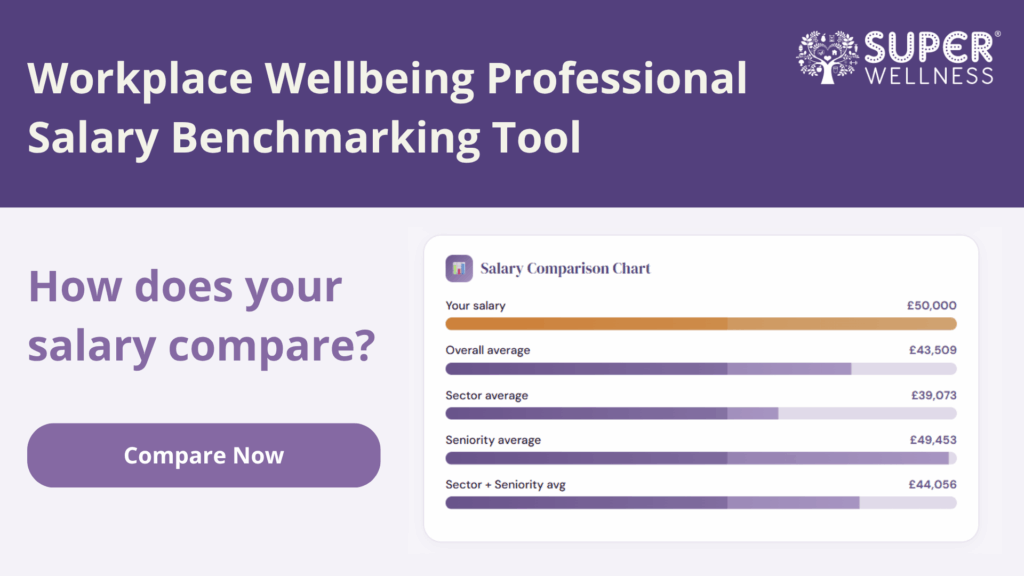
The tool provides a straightforward way to benchmark salaries.
It allows you to:
- View salary ranges by role level and sector
- Compare your own salary against this data
- Understand where you sit within the current market
It is not static. As more people contribute and more roles are added, the picture becomes increasingly accurate.
How it can be used
The value of the tool depends on how it is used both by individuals and organisations.
For individuals, the main benefit is having a clearer external reference point.
It can be used to:
- Assess whether your current salary reflects your role
- Identify gaps between your salary and the wider market
- Support salary conversations with evidence
Salary decisions are often based on limited or internal information, so having access to external data helps provide a more balanced view.
For organisations, the tool supports how roles are defined and advertised.
It can help to:
- Benchmark salary ranges against the current market
- Improve consistency between similar roles
- Avoid underpricing or overpricing roles
If workplace wellbeing roles are responsible for improving employee experience, they need to be positioned and valued accordingly.
A step towards a more defined profession
Workplace wellbeing is still developing as a profession.
As it grows, there is a need for more consistency in:
- Role definitions
- Career pathways
- Salary expectations
This tool is one step towards providing that clarity.
Final thought
The aim of the Workplace Wellbeing Salary Benchmarking Tool is to make pay in the profession more transparent and easier to understand.
That depends on building a stronger, shared dataset over time.
If you work in workplace wellbeing, you can use the tool to see how your salary compares and contribute to improving the data for others.
Complete the Workplace Wellbeing Salary Benchmarking Tool to benchmark your salary and help build a clearer, more consistent view of pay across the profession.
About the author:
Elliot Foster is the Head of Wellbeing Strategy, and Course Director of the Accredited Level 5 Diploma in Leading Strategic Workplace Wellbeing at SuperWellness. The only qualification based on the Workplace Wellbeing Profession Map™. Through the qualification, he helps Workplace Wellbeing Professionals to be more evidence-based and strategic in their work, both increasing their confidence and improving the outcomes of their work.
With an MSc in Organisational Psychology, and experience working with both national and global organisations, he ensures that workplace wellbeing shifts from being a “nice-to-have” to a driver of business success.
You might also like: