The Make a Difference Leaders’ Club brings together employers with a shared ambition: to drive forward best practice in workplace culture and employee health and wellbeing.
But an important question sits at the heart of that mission – are we really making a difference?
That question sparked a lively discussion at our Steering Committee meeting. Members agreed that if the community is serious about improving workplaces, it needs to be able to demonstrate the impact it is having – year on year – across organisations of different sectors, sizes and structures.
After all, at a time when employers are increasingly expected to measure the effectiveness of their initiatives, we believe we should hold ourselves to the same standard.
So, with our first impact report, we set out to do exactly that.
Taking a snapshot of the landscape
To establish a baseline, we developed a short survey in partnership with Ipsos Karian and Box. The aim was simple but important: to better understand where organisations are today, what challenges they are facing, and how approaches to workplace culture and employee health and wellbeing are evolving.
The survey allowed us to:
- Gather insight from both Leaders’ Club members and the wider employer community
- Capture a snapshot of the most pressing workplace culture, health and wellbeing issues organisations are navigating
- Establish a benchmark that will allow us to track progress over time
At its core was a section designed to understand organisational maturity – what we called “Where you are now.” This will allow us, in future years, to see how strategies evolve and whether being part of the Leaders’ Club helps accelerate progress.
Importantly, the findings won’t just sit on the shelf gathering dust. They will shape the topics we prioritise, the conversations we host and the insight we share across our network.
The survey itself was structured around three perspectives: looking back at 2025, where you are now, and looking ahead to 2026. It also included a section inviting Leaders’ Club members to share feedback on activities delivered during 2025, along with suggestions for what they’d like to see more of in 2026.
Who took part
In total, 136 employers responded – representing over one million employees – providing a valuable cross-section of organisations.
Just over half (58%) came from the 600 Leaders’ Club members polled, with the remaining 42% drawn from the wider www.makeadifference.media network. Respondents represented organisations across multiple sectors and sizes, though member respondents were more likely to come from larger organisations – with almost a quarter working in legal or financial services.
Member respondents were also slightly more likely to hold senior roles with broader responsibility. Around 44% reported having regional or global remits, compared with 40% of non-members. Unsurprisingly, Leaders’ Club respondents were also more likely to have employee health and wellbeing explicitly included within their responsibilities.
What actually counts as “employee health and wellbeing”?
One of the most interesting early findings was how broadly organisations now define employee health and wellbeing.
When respondents were asked to share their opinion of what sits within a health and wellbeing programme, the answers reflected a discipline that increasingly touches almost every part of working life.
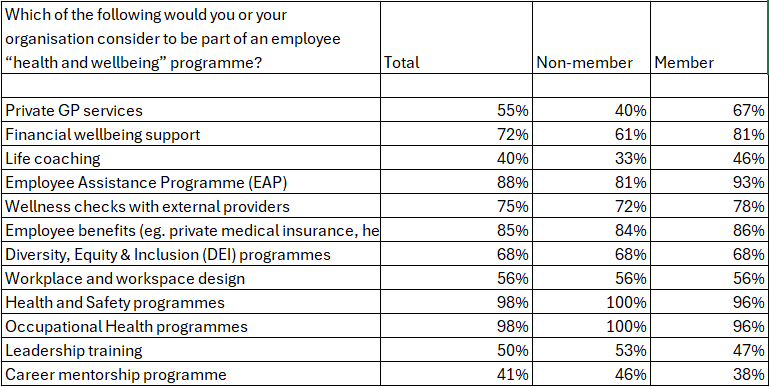
Health and safety and occupational health were most commonly seen as the foundations of health and wellbeing strategies, followed by employee assistance programmes and employee benefits. But the picture doesn’t stop there.
Respondents also highlighted elements such as:
- Healthy food provision
- Ergonomic assessments and workplace design
- Flexible working and workload management
- Resilience and leadership training
- Physiotherapy and addiction support
- Psychological safety initiatives
- Peer networks and Mental Health First Aiders
- Internal communications and education programmes
Financial wellbeing was notably more likely to be seen as integral by Leaders’ Club members than non-members. Meanwhile, 68% of both groups said inclusion should be considered a core component.
As one respondent neatly put it:
“All of these contribute to employee health and wellbeing outcomes, but may not all sit under the wellbeing umbrella.”
From programmes to systems
Perhaps the clearest message emerging from the responses is that organisations are moving beyond standalone initiatives.
Many respondents described wellbeing as something that must be embedded across the entire employee experience – not delivered as a series of bolt-on programmes.
Culture, leadership behaviours, organisational policies and ways of working were all seen as part of the equation. Psychological safety also emerged repeatedly as a defining ingredient.
Most definitions referenced a broad mix of wellbeing dimensions, typically including: mental, physical, financial, and social/emotional health and wellbeing.
At the heart of many responses was a similar aspiration: creating the conditions for people to thrive, be their best at work and sustain high performance over time.
Responses also acknowledged both the organisational responsibility (culture, environment, policies) and the importance of individual factors – emphasising the need for approaches that are inclusive, equitable, and based on employee needs and evidence.
Signs of progress in 2025
We also asked respondents to reflect on one action they had taken in 2025 that advanced workplace culture or employee health and wellbeing.
The range of responses was striking – reflecting the very different stages organisations are at in their journeys.
- Training & Education: A significant focus was placed on training, including Mental Health First Aid, Line Manager training in Psychological Safety, having supportive conversations, Menopause Champions, Healthy Leadership training, and Reasonable Adjustment training.
- Wellbeing Initiatives & Support: Organisations introduced or enhanced various support mechanisms such as: increasing paid carer’s and paternity leave, enhancing benefits with a focus on neurodiversity, fertility and menopause, implementing financial wellbeing webinars and education, and developing targeted local wellbeing interventions. The shift from reactive to preventative wellbeing support was also mentioned.
- Networks & Community: Many responses indicated the creation, realignment, or strengthening of networks, including Wellbeing Champions/Ambassadors/Ally Networks, Mental Health First Aiders/Champions, Freedom to Speak Up Guardians, and specific networks for Family/Carers, Disability, and LGBTQ+. The establishment of Menopausal Cafes and fostering open conversations were also noted.
- Culture and Strategy: Actions included developing and launching new, refreshed, or three-year rolling Wellbeing Strategies, reviewing culture and values and implementing a new people-centric performance review. There was also a focus on data and research to drive evidence-based decisions, including studies on breaks, recruitment/retention, and mental health.
- Work Environment & Flexibility: Enhancements to the physical workspace, such as achieving WELL Platinum certification and pioneering neurodivergence and sensory considerations in office design were highlighted. Additionally, promoting flexible working and simple measures such as encouraging lunchtime walks were mentioned.
Together, the responses paint a picture of organisations experimenting, learning and gradually embedding new approaches.
Benchmarking insights and implications
The analysis of the responses to the benchmarking questions in the survey, comparing the responses of members to non-members, reveal four major themes:
1. Allocating formal responsibility for health and wellbeing advances impact
Leaders’ Club members are more likely to work for organisations where employee health and wellbeing strategies are partially or fully integrated across the whole organisation (74% of members vs. 58% of non-members). This structural positioning appears to be linked to slightly higher implementation maturity scores across strategy questions.
Implication: Clearly linking employee health and wellbeing strategy to business objectives appears to accelerate implementation progress.

2. Leaders’ Club members are slightly further ahead on strategy implementation – but systemic gaps remain across all organisations
Members tend to score slightly higher on implementation – likely reflecting the fact that more members hold health and wellbeing directly within their remit. However, on some measures, the gap between members and non-members is relatively small. The biggest shared challenges are clear:
- Clarity of responsibility for health and wellbeing outcomes
- Leadership involvement and visible ownership
- Measurement and ability to demonstrate impact
There are also notable gaps in fully linking wellbeing strategy to organisational values and DE&I — even where strategy intent is strong.


Implication: The next phase of organisational maturity is less about designing strategy, and more about assigning responsibility, leadership behaviour and measurable impact.
3. Organisations are seeing improvement in health and wellbeing-related people metrics – but trust remains challenging.
Respondents reported the strongest positive movement in wellbeing-related people metrics over the past 12 months. This suggests investment and activity are having real impact. However, trust in leadership remains the lowest-scoring people outcome.
This is significant. It suggests that while support is increasingly available, workforce belief in leadership consistency, transparency and authenticity may still be developing.
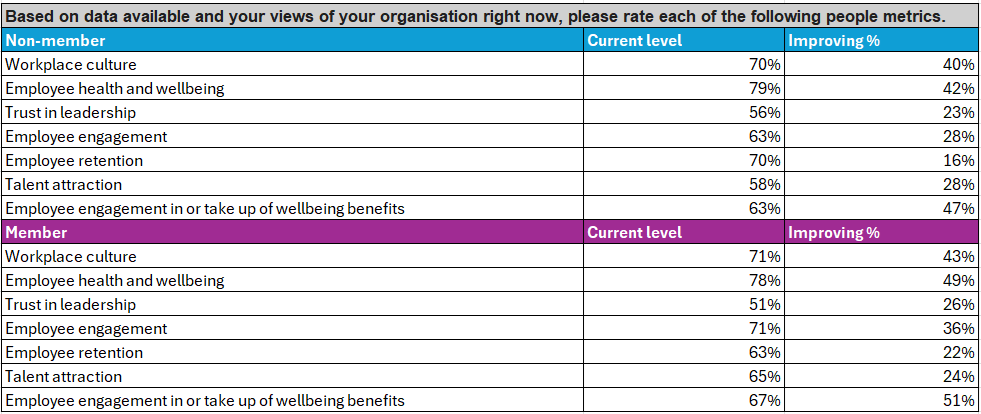
Implication: Health and wellbeing programmes alone do not drive culture change. Leadership behaviour and credibility remain the biggest multipliers of impact.
4. Strategic priorities of members and non-members differ.
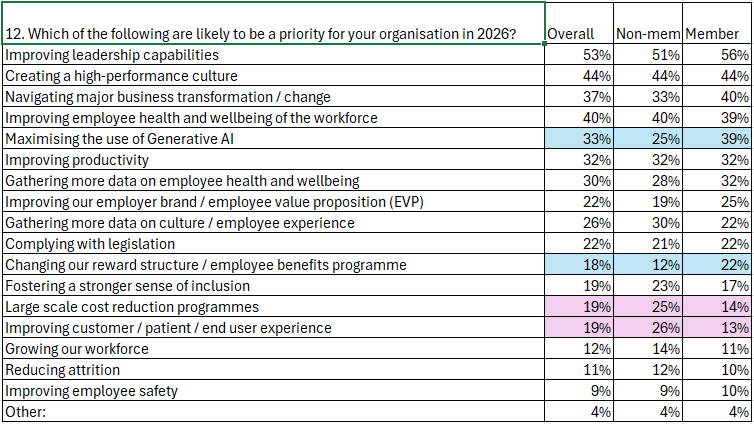
Members are leaning into AI and strategy evolution, while non-members remain more focused on cost and customer pressures. When asked about priorities for 2026, clear differences emerged:
Leaders’ Club members are more likely to prioritise:
- AI usage and governance (for more on this join our free-to-attend AI and Work webinar on 17th March)
- Reward and employee benefits structure evolution – with financial wellbeing more likely seen as part of health and wellbeing strategies than previously
- Future workforce capability and change readiness
Non-members are more likely to prioritise:
- Cost reduction
- Customer experience delivery
When asked to expand on these selections, respondents’ explanations were far-ranging:
Organisational change and transformation: Their organisations are undergoing major changes, including restructuring, acquisitions, mergers, transformation programmes, new service introductions, and adapting to a tight budget/cost-reduction environment. These changes necessitate a focus on stabilising the organisation, embedding new strategies, and supporting employees through change.
Leadership capability and manager development: Improving the capabilities of leaders and managers is a central theme, viewed as key to enhancing the employee experience, improving wellbeing, supporting organisational success, embedding initiatives, and building a high-performance culture.
Business growth and performance: Priorities are driven by the need to achieve business growth, improve overall performance, drive efficiency, meet targets, and maintain a competitive edge. This includes creating a high-performance culture that is sustainable and balanced with employee wellbeing.
Artificial Intelligence (AI) and technology: The integration and adoption of AI is a significant priority for many, seen as key to growth, improving productivity, streamlining processes, and staying relevant in a changing industry. Questions also remain around governance, ensuring AI doesn’t increase burnout risk and understanding how it can realistically be used to support employee health and wellbeing.
Employee wellbeing and retention: Organisations are prioritising health and wellbeing to reduce burnout, improve retention, address high attrition, and respond to employee feedback and engagement results. There is also a push for more data-driven and strategic approaches to wellbeing.
Looking ahead: from benchmark to momentum
This first Leaders’ Club Impact Report provides something the community has never had before: a benchmark we can measure progress against.
In the years ahead, we will be able to track:
- Whether Leaders’ Club membership correlates with faster strategy maturity
- How organisational priorities shift as economic, technological and workforce pressures evolve
- How workplace culture, employee health and wellbeing maturity progresses year on year
But perhaps the most important insight isn’t contained in any single data point.
Across every response runs the same underlying belief: workplaces improve faster when organisations learn from one another.
And that is exactly what the Make a Difference Leaders’ community exists to do.
Since 2024, Personify Health has proudly sponsored the Leaders’ Lunches, supporting meaningful conversations around health and performance. As a global personalised health platform, Personify Health brings prevention and health navigation together in one seamless experience, helping organisations reduce risk, manage costs, and deliver measurable outcomes. Powered by AI and data-driven insights, it empowers individuals to take proactive steps toward better health while giving organisations the clarity and confidence to invest in prevention. Speak to the Personify Health team to explore how a prevention-first strategy can strengthen your people, enhance performance, and deliver measurable value for your organisation – Contact Us Demo – International Personify Health.
Special thanks also to the team at Ipsos Karian and Box for supporting the development of the survey, hosting the November Leaders’ Lunch where it was launched, and crunching the numbers to produce the report’s insights.
You might also like: