
Keynote speaker Andy Haldane told Make A Difference Media’s Leaders community that workforce health is inseparable from business performance. But with budgets under pressure, employers need more than another wellbeing ROI statistic. They need to understand what poor health is costing them, what is driving it, and whether their actions are making a difference.
When Andy Haldane took to the stage at Make A Difference Media’s recent AGM & Leadership Forum, he had a message that went beyond the familiar calls to invest in employee wellbeing.
The former Bank of England chief economist argued that workforce health is inextricably linked to business performance and UK economic growth. Despite the economic, demographic and technological pressures facing employers, businesses have an important role to play in keeping people healthy and economically active.
Litany of nasty shocks
“We have faced a litany of nasty shocks. Economic, financial, social, ecological and geopolitical,” he told delegates.
“Most businesses under-invest in the health of their staff. We need to ensure people remain healthy as well as skilled if they are to remain in the workplace.”
The challenge is becoming more urgent, with millions of working-age people claiming health-related benefits, an ageing workforce, rising ill health among younger people and AI reshaping entry-level work.
“Business practices, cultures and models will need to change fundamentally if we are to rise to those demographic and technological challenges,” Haldane said.
Health: an asset, not an optional extra
Employers have long been presented with the well-worn Deloitte estimate that every £1 invested in employee wellbeing delivers £4.70 in returns. But has that statistic become wallpaper?
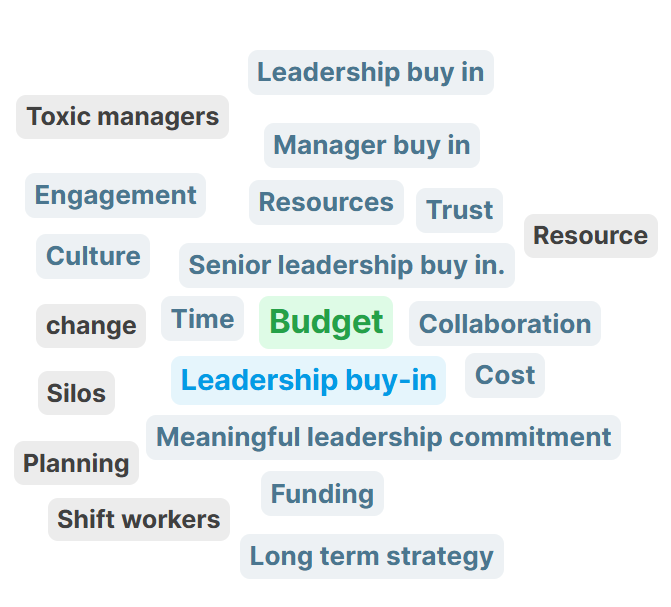
Delegates at the AGM identified budget cuts as their biggest challenge, with “budget” among the most-mentioned words in our on-the-spot poll.
When money is tight, a generic ROI figure may not be enough. A more pressing question is: what is poor workforce health costing the business now, and what will it cost if nothing changes?
Sir Charlie Mayfield’s Keep Britain Working review estimated that ill-health-related inactivity costs the UK economy £212bn a year, including around £85bn in lost employer output. Around 2.8 million people are out of work because of long-term sickness.
Health = Capital
Haldane has described health as “a source of capital that needs continuous investment and replenishment if we are to grow, if we are to be resistant to future shocks”.
Businesses would rarely treat physical assets, technology or skills as optional extras. Yet employee health is often treated as a discretionary luxury, vulnerable to the next round of cuts.
Ill health is pushing some older workers out of employment before they are ready to leave, while young people struggle to enter and remain in work. Haldane’s call for “earning and learning”, and closer collaboration between government, business and society, reflects the scale and ambition of the challenge.
Not everyone agrees employers should carry more responsibility, though. Lucy Heller, Ofsted Board Member and former ARK CEO, warned: “We’re asking too much from businesses, or the wrong thing from businesses. To me, the most important thing businesses can do at the moment is provide good, solid jobs.”
She’s right that employers cannot be expected to solve every social or health problem. But can they afford to ignore workplace conditions that contribute to ill health, absence and people leaving employment completely?
Wellbeing activity isn’t the same as healthier work
One risk is that “wellbeing” becomes shorthand for awareness days, apps, workshops and other individual-level interventions (which we’ve written about copiously on www.makeadifference.media).
High-profile research from Oxford’s Wellbeing Research Centre, led by William Fleming, has questioned whether these workplace offers reliably improve employee wellbeing. Evidence increasingly points to the work itself having more of an effect: workload, job design, management and the conditions in which people are expected to perform.
Liton Ali, co-founder of metabolic health platform Nico, believes employers need to look beyond surveys and measure what happens when they change the work.
“I don’t think many employers are measuring what happens when you reduce the pressure of the work itself,” he says.
Changing work structure
The 2022 four-day-week pilot involving 61 UK companies offers one example. It reported a 65% fall in sick days, while revenue was broadly maintained.
CIPD research has also identified heavy workloads as a leading cause of stress-related absence. The point is not that every employer should adopt a four-day week, but that changing the work and structure may be more effective than asking employees to become more resilient to the stresses inherent in it.
“If you can’t see what ill health is costing you” says Ali, “and many employers can’t, wellbeing looks like an optional extra, and it’s the first thing to go when money is tight.”
The false economy, he argues, is cutting the work that tackles what is actually making people ill, whether workload or poor metabolic health, and measuring the result in pounds.
From measuring activity to measuring outcomes
Better data and measurement are at the heart of Mayfield’s Keep Britain Working work. The aim is not to tell every employer exactly what to do, but to help them understand workforce health challenges, identify what good looks like and judge whether their efforts are working.
In his Make a Difference Leaders podcast with us, Mayfield explained that the review team is developing questions to give employers a clearer picture. These include asking employees:
- To rate how well their health enables them to do their job
- How likely they are to need five or more days off for ill health in the next three months
- How confident they feel discussing health with their line manager.
Recognising that employees may not feel safe sharing sensitive information directly, the team has developed a prototype app that asks questions confidentially. Individual results are visible only to the employee, while employers receive aggregated information.
Spotting trends
This could help organisations spot trends, such as emerging mental health issues or falling confidence in line managers, and compare them with benchmarks.
“If you had that information as an employer, it’s very actionable,” Mayfield told us.
The data should prompt questions, not simply produce another dashboard. Falling confidence in managers, for example, might lead an employer to examine leadership behaviours, training or how support is communicated.
Mayfield is keen to avoid a box-ticking exercise. Employers should agree on the principles and outcomes that matter, then take responsibility for how they achieve them.
Move beyond counting interventions
One example is successful return to work, which Mayfield said very few employers currently measure. Yet one of the review’s vanguard employers reported a 40% improvement in retention after it began measuring return-to-work outcomes.
“They don’t need us to tell them how to do that,” he said. “It’s much better that they take responsibility for the how.”
The challenge is to move beyond counting wellbeing interventions and understand the outcomes they achieve: whether people can do their jobs in good health, feel able to speak up, remain in work when their health changes and whether organisations are addressing the conditions making people ill.
The business case is not simply about proving that a wellbeing programme generates a return. It is about recognising that a healthy workforce is part of the infrastructure on which productivity, resilience and growth depend.
If you would like to receive the post-event report, as well as invitations to closed-door, sales-free, virtual roundtable discussions, regular Leaders’ Lunches and more, apply to join Make a Difference Leaders free here.
You might also like: