
Recent discussions at the Make a Difference Legal Sector roundtable highlighted the growing challenge of sustaining high performance in an increasingly pressured environment.
For legal professionals, the demands are familiar: accuracy at pace, high cognitive load, constant deadlines and the need to remain composed, often while navigating uncertainty and competing priorities.
But sustained pressure does not simply affect how much work people can do. It can also change how they think, communicate, collaborate and behave.
Understanding what happens when pressure rises may therefore be an important part of creating healthier workplace cultures and more sustainable high performance.
What happens when pressure puts the nervous system on alert?
One pattern that appears repeatedly in professional teams is the Drama Triangle – a cycle of Victim, Persecutor and Rescuer roles first described by Stephen Karpman (1968). These are stress response behaviours, which reliably show up in the patterns identified through HSE Stress Risk Assessments.
This article explores the individual ecosystem: what happens inside us when pressure rises, how our body reacts, how our brain interprets it, and the behaviours we slip into without realising. As explored in Sustainable High Performance in Legal Practice, autonomic agility is the foundation of sustainable high performance.
The Drama Triangle as a stress response pattern
While not a diagnostic tool, the Drama Triangle is a simple lens for recognising reactive patterns that surface under sustained pressure and lowered psychological safety. These are temporary behavioural states, not fixed personality traits – autonomic responses to perceived threat. It’s important to emphasise that these patterns are common in high‑pressure environments and should not be read as pathology or personality flaws. Anyone can move into them when cognitive load rises or psychological safety drops.
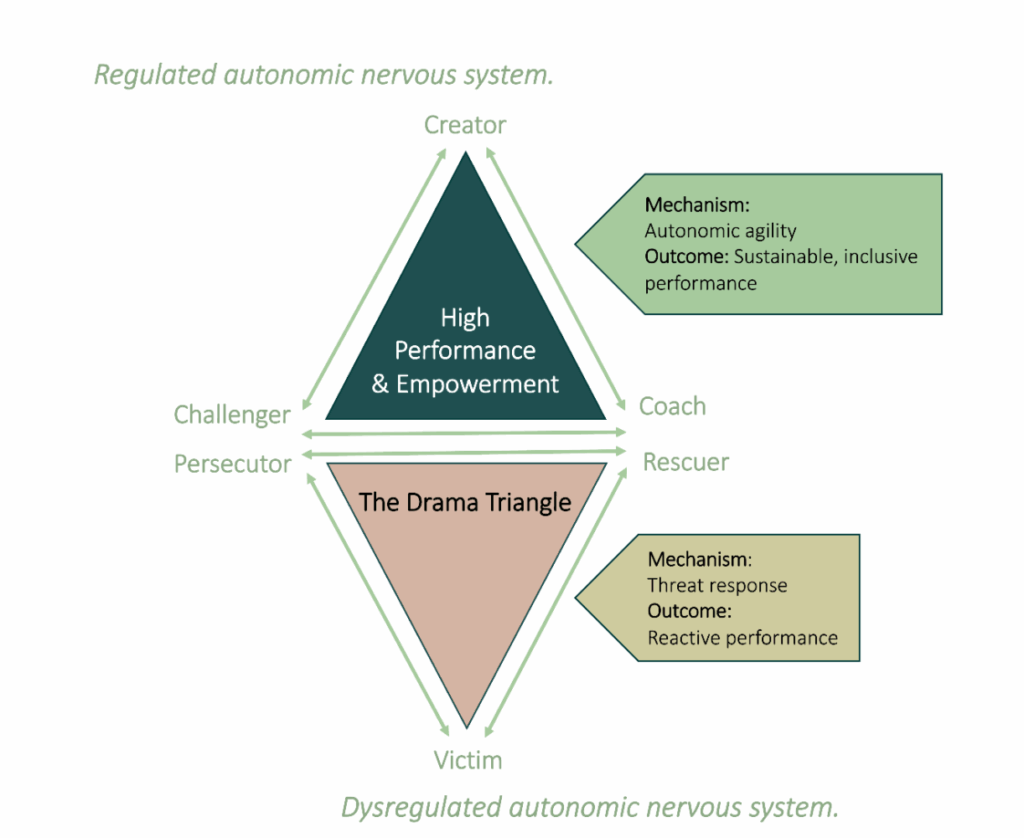
Victim — Reduced Agency
- Looks like: withdrawing, passing responsibility, freezing under pressure.
- Typical phrases: “I can’t deal with this right now.” “Everything feels too much.”
- Workplace patterns: waits for direction, avoids decisions, hesitates to take initiative.
Persecutor — Control Based Responses
- Looks like: urgent, critical, directive behaviour.
- Typical phrases: “Why hasn’t this been done?” “This isn’t good enough.”
- Workplace patterns: micromanages, escalates tone or pace, scrutinises small details.
Rescuer — Over Functioning
- Looks like: stepping in prematurely, absorbing responsibility.
- Typical phrases: “I’ll sort it, don’t worry.” “I don’t want them to struggle.”
- Workplace patterns: shields people from pressure, fixes problems before others have a chance.
How threat cues shape reactive roles in teams
While past experiences can prime the nervous system to react more quickly to pressure – such as exposure to high‑conflict households, financial instability, racism or code‑switching – similar trigger responses can also arise purely from workplace conditions. Persistent high workload, ambiguity and sustained urgency can produce the same autonomic reactions, making these patterns universal rather than identity specific.
When psychological safety drops or uncertainty rises within work micro‑climates, teams become more reactive. Some people step in too early, take on extra responsibility and absorb pressure to keep things steady. Others respond by tightening their grip – increasing scrutiny, pushing for pace or becoming more directive in an effort to regain control. Together, these pressure driven behaviours can create a feedback loop where the system unintentionally reinforces the very patterns it’s trying to resolve.
Dependency loops
Over time, these behaviours form dependency loops: over functioners become team stabilisers, others begin to lean on them, and leaders tighten control to regain predictability. While this sustains short-term results, it risks constraining long-term capability.
This causal chain is well supported across neuroscience, trauma psychology, organisational behaviour and emotional labour research.
Threat cues → Adaptive stabilising responses → Dependency loops → Capability constraints
Regulated leadership as the alternative
Leaders who build high performing environments do not run in and rescue – they coach. Nor do they tighten control – they challenge constructively. They are work-culture climate shapers.
By acting in regulated, sustainable ways, they create healthier microclimates that enable the wider firm ecosystem to become psychologically safer and more empowering.
High performance and empowerment
David Emerald’s The Empowerment Dynamic (TED) reframes Drama Triangle states into more resourceful roles: Creator, Challenger, Coach. Individuals can access these roles when their nervous system is regulated. As discussed in Sustainable High Performance in Legal Practice, autonomic agility is the pathway to that regulation.
Creator — Agency
- Looks like: taking ownership, focusing on possibilities.
- Typical phrases: “Here’s what I can do.” “Let’s move this forward.”
- Workplace patterns: initiates, stays resourceful under pressure, moves conversations forward.
Challenger — Clarity
- Looks like: raising expectations constructively, inviting growth.
- Typical phrases: “What’s the real priority here.” “How can we do this better.”
- Workplace patterns: offers constructive challenge, encourages accountability, pushes for clarity without blame.
Coach — Support
- Looks like: enabling others to think, decide and act.
- Typical phrases: “What outcome are you aiming for.” “Talk me through your thinking.”
- Workplace patterns: asks thoughtful questions, builds capability, supports regulation under pressure.
When individuals shift into the Empowerment Dynamic, teams become more inclusive, more empowered and more capable of sustaining high performance through autonomic agility.
Why this matters for performance
When individuals shift into a threat response state, their behaviour is often misinterpreted as capability issues or interpersonal conflict. Yet these reactions are not reflections of character or competence – they are physiological and relational responses to pressure.
Understanding how the autonomic nervous system shapes behaviour allows us to read reactions more accurately: not as personal failings, but as predictable responses driven by internal states and environmental conditions.
These reactive autonomic states also carry commercial risk in legal practice. When judgement, clarity and precision are compromised – especially under pace – decision quality drops, error likelihood increases, and regulatory and conduct risks escalate. In a sector where cognitive performance directly affects client outcomes, the cost of dysregulation is measurable.
You might also like: