
The UK labour market is showing signs of recovery. But beneath the surface, a more complex and potentially concerning shift is underway.
New data from HR, hiring and payroll software provider Employment Hero’s March Jobs Report, based on over 125,000 employee records across small businesses, reveals a growing divide between full-time and part-time employment. While overall hiring is improving, employers are increasingly favouring stability, with implications for workforce inclusion, flexibility and wellbeing.
A polarised labour market is emerging
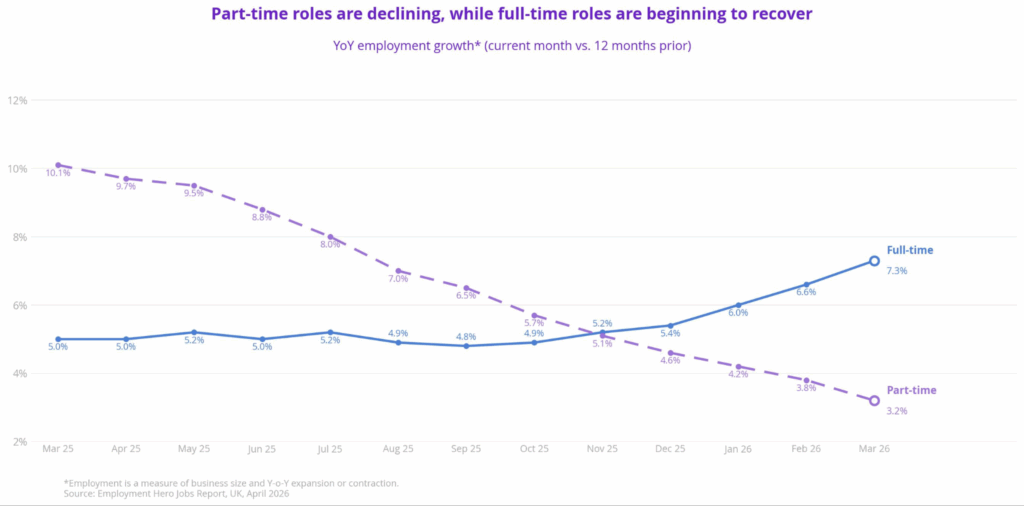
According to the report, full-time employment among SMEs rose by 1.1% month-on-month in March. In contrast, part-time roles declined for the third consecutive month, falling by 0.5%.
This divergence suggests a polarisation of the labour market, with organisations making more deliberate choices about workforce structure in response to ongoing economic and regulatory pressures.
For employers, this reflects a shift towards:
- Greater certainty in workforce planning
- Reduced complexity in managing contracts
- A focus on long-term stability over flexibility
However, this trend raises important questions about access to work and the future of flexible employment.
Disproportionate impact on older workers and women
The contraction in part-time roles is not being felt evenly across the workforce.
While part-time work is often associated with younger employees, data from the Office for National Statistics shows it is more commonly held by older workers and women – groups now most affected by the decline.
Employment Hero’s data highlights:
- A 6.2% drop in part-time roles among Baby Boomers (month-on-month)
- A 2.7% decline for Gen X and 1.3% for Gen Y
- A 5% increase for Gen Z, suggesting a generational shift
The gender disparity is particularly striking. Among older workers:
- Part-time employment for women has fallen by 4.3% year-on-year
- Meanwhile, it has risen slightly (0.4%) for men
This suggests the decline in part-time roles could disproportionately impact older women’s participation in the workforce, with potential consequences for diversity, inclusion and economic equality.
SMEs prioritising long-term stability
Looking at longer-term trends, the data shows a clear employer preference for full-time roles.
Over the past year:
- Full-time employment has grown by 14.6%
- Part-time roles have increased by just 3.3%
This reflects a broader shift among SMEs towards more stable, predictable employment models, particularly as they navigate:
- Rising operating costs
- Increased regulatory complexity, including the Employment Rights Act
- Ongoing economic uncertainty
While this demonstrates resilience, it also suggests that many businesses are becoming more cautious—hiring selectively rather than scaling rapidly.
Wage growth remains high—but under pressure
The report also highlights continued pressure in the labour market through elevated wage growth.
Year-on-year wage growth remains high at 8.8%, indicating that employers are still competing for talent despite wider economic challenges.
However, there are early signs of strain:
- Wages fell by 1.1% month-on-month in March
- The North of England saw the sharpest decline, down 2.6%
With inflation continuing to impact real incomes and business costs rising, questions remain about how sustainable this level of wage growth will be.
What this means for workplace culture, health and wellbeing
These labour market shifts have important implications beyond hiring trends.
A move away from part-time roles could:
- Reduce access to flexible work for those balancing caring responsibilities
- Increase pressure on employees who require non-standard working patterns
- Impact workforce diversity, particularly for older women
At the same time, the focus on stability may bring benefits, including:
- Greater job security for full-time employees
- More consistent team structures
- Improved continuity in roles and responsibilities
However, employers will need to balance these benefits against the risk of excluding talent pools that depend on flexibility.
A more selective approach to hiring
Commenting on the findings, Employment Hero’s UK Managing Director Kevin Fitzgerald said the headline recovery masks a more complex reality.
He noted that the labour market is “quietly restructuring,” with employers making calculated decisions about workforce composition in response to legislative and economic pressures.
Rather than expanding hiring aggressively, many SMEs are becoming more selective—prioritising roles that offer long-term value and stability.
The bigger picture: access to work in a changing market
As the UK labour market continues to evolve, the divergence between full-time and part-time roles could have lasting consequences.
For employers, the challenge will be to:
- Maintain stability while preserving access to flexible work
- Ensure workforce strategies support inclusion as well as efficiency
- Align hiring decisions with long-term culture and wellbeing goals
For policymakers and industry leaders, the findings raise broader questions about how to ensure that shifts in employment patterns do not inadvertently limit participation for key groups.
You might also like: